cosas - Hallo sahabat
fashion, Pada Artikel yang anda baca kali ini dengan judul cosas, kami telah mempersiapkan artikel ini dengan baik untuk anda baca dan ambil informasi didalamnya. mudah-mudahan isi postingan
Artikel Action Step,
Artikel cosas,
Artikel Grassroots, yang kami tulis ini dapat anda pahami. baiklah, selamat membaca.
Judul :
adult history All Out for West Contra Costa Adult School - japraklupolink :
adult history All Out for West Contra Costa Adult School - japraklupo
Baca juga
cosas
Even as things are generally improving for Adult Schools and Adult Education, yet another Adult School faces a serious challenge. This time, it's West Contra Costa Adult School, where Kristen Pursley, author of the Save Your Adult School blog and founder of COSAS (Communities United to Save Adult Schools), works. Other COSAS members work there, as well. Many parts -if not all of - the Adult Ed program at WCCAS is under threat of dissolution.
West Contra Costa Unified School District serves a population where almost 60% of the kids live with one or more foreign-born parent and 25% of the children live in poverty. (
Kidsdata.org) I think we can safely assume Adult Education is needed.
Supporting adults with language, civic, community, and job skills directly benefits school age children.
What the heck is the West Contra Costa Unified School District thinking?Visit this Save Your Adult School blog post for a list of Adult School Teachers United concerns.Hit the "read more" link to learn more.The reasons behind the crisis at WCC Adult School are complex. Part of the problem is the ongoing instability of state funding. Until we know exactly what Adult Schools will receive and how the funds will be channeled, all Adult Schools are vulnerable to bad behavior and poor choices. Another problem is bad behavior and poor choices that have no direct relation to the crisis which Adult Education has been weathering since 2009.
And a third part is what I see as a misguided attempt to fix kid problems by seeing and dealing with kids as disconnected from their families and their communities. Do the kids in your district have problems? Are their test scores low? Are they hungry? See and treat them in isolation. Do not see them as members of groups which, if given proper support, could help those kids thrive. See the kids - and the families and communities from which they come and in which they live - as separate entities - and from a deficit perspective. My question about that approach: Has it worked so far? And since the answer is always no, please consider this statement: Maybe that's because all kids of any ethnicity and any income bracket are part of families and communities. Understanding and supporting kids happens best and fastest when you also understand and support the families and communities in which they live and grow. And just in case it's not clear:
that all works best when you do it from an asset perspective. (If you're wondering about this asset and deficit thing it's basically whether you start with what you think is wrong with something or someone or whether you start with what you see is right with them. If you're confused about that, ask a member of your family. They can probably tell you in a hot minute the perspective you use.)
Hard-ball candy version of the previous paragraph: When you were a kid, how did you want to be seen and understood and treated? If you have kids, how do you want them to be seen and understood and treated? If you answered, "as part of a family and community that has worth," you got it.
Here is some information about the upcoming May 6th meeting of the West Contra Costa Unified School District Board, contact info for the board, as well as a letter from a lawyer. The letter is a matter of public record and can be shared.
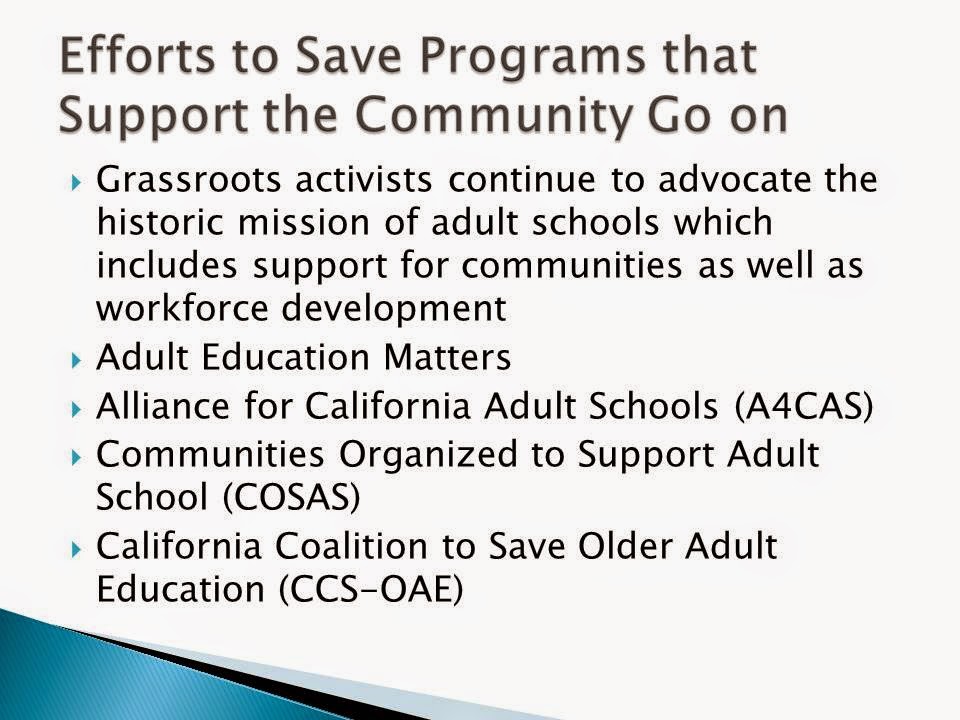
Kristen and COSAS have been invaluable leaders in the work to save Adult Schools and Adult Education. Please stand up for them now. Send an email. Share the info. And
sign the Restore Protected Funding Petition. Remind others that until all of us are all the way through this passage, none of us are truly safe.
It took some years for folks to connect with each other to form a larger movement to save Adult Schools and Adult Ed - but connect and form it we did.
Now is the time to use it!WEST CONTRA COSTA ADULT ED NEEDS OUR SUPPORT!
If you are unable to attend the board meeting on May 6th, please take a moment to send an email to West Contra Costa Unified School District Board members and stand up for our friends at WCCAE. Kristen Pursley and many of the members of COSAS (Communities Organized to Support Adult Schools) work at WCCAE. They have done a tremendous amount of work to secure the future of Adult Ed statewide and now they need all of us to support their efforts to save their school.
Here are the email addresses of the board members:
Ask them NOT to close adult ed classes. Ask them NOT to lay off adult ed teachers. Ask them NOT to cut the babysitting staff. Ask them to support their adult ed teachers and provide them with the rights they deserve, as mandated by law.
Tell them that and we stand together in the struggle to secure the future of K-12 Adult Ed in California.
|
|
|
LAW OFFICES OF
ROBERT J. BEZEMEK ROBERT J. BEZEMEK
PATRICIA LIM A PROFESSIONAL CORPORATION
DAVID CONWAY THE LATHAM SQUARE BUILDING
1611 TELEGRAPH AVE., SUITE 936
OAKLAND, CALIFORNIA 94612
Telephone: (510) 763-5690 ! Facsimile (510) 763-4255
April 16, 2015
Superintendent Bruce Harter, Ph.D.
West Contra Costa Unified School District
1108 Bissell Avenue, Room 100
Richmond, CA 94801
President and Members of the Board of Education
of the West Contra Costa Unified School District
1108 Bissell Avenue
Richmond, CA 94801
West Contra Costa Adult Education
Re: Rights of Adult Education academic employees
Dear Superintendent Harter and Members of the Board of Education,
I write on behalf of Adult School Teachers United (“ASTU”), a labor organization
composed of academic employees employed by the District at the West Contra Costa Adult
Education unit. The faculty of the West Contra Costa Adult Education schools are presently not
represented by an exclusive bargaining agent.
This letter has several purposes. First, to notify the District that the West Contra Costa
Adult Education schools are currently being organized for purposes of representation under the
EERA by the ASTU. This letter provides this notice to assure that the District takes no action to
interfere, restrain, coerce or discriminate against employees in regard to their rights of selforganization under the law.
Second, to bring to the District’s attention a number of District actions which violate the
California Education Code, and to request that it take prompt and effective action to remedy
these violations.
Third, to assure that the District understands that it has a legal obligations to meet and
confer with a labor organization representing some of its otherwise unrepresented employees,
West Contra Costa Unified School District even when that organization has not yet achieved exclusive recognition by the District, or certification by the Public Employment Relations Board as an exclusive bargaining agent of Adult School employees.
Having had extensive experience with the West Contra Costa Unified School District in
prior years,1 I hope that the District will act promptly to rectify various matters discussed in this
letter.
I. Organizing of Adult Education Employees
The ASTU hereby gives formal notice to the District that it is conducting a campaign to
organize the unrepresented West Contra Costa Adult Education academic employees. ASTU
wishes to remind the District that employees are entitled to engage in union organizational
activities on school premises, during non-work time. .
In addition, we emphasize that the District and its Adult Education division is forbidden
by the Educational Employment Relations Act (“EERA”) from interfering, restraining or
coercing employees in their exercise of their organizational rights. To that end, the District is
prohibited from engaging in surveillance of union activities, and is forbidden from taking action
to discourage employees from choosing to organize a labor organization or from seeking
recognition from the District. This letter is not a demand for recognition as an exclusive
representative, but it does ask that the District acknowledge its statutory duty to confer with
ASTU as a representative of unorganized employees of the Adult Education Division (“Adult
School”).
II. The Right of ASTU to Meet and Confer With the District
and to Represent Its Members
The PERB has consistently affirmed the rights of non-exclusive organizations such as
ASTU to meet with the District, and to receive notice from the District, of policy actions which
may affect the wages, hours or terms and conditions of Adult School employees. Mt. Diablo
Unified School District. (1977) EERB Decision No. 44. Clovis Unified School District (1984)
PERB Decision No. 389 and Santa Monica Community College District (1977) PERB Decision
No. 103; Los Angeles Unified School District (1983) PERB Decision No. 285.
______________________________________
1 In 1991 I represented the Richmond Federation of Teachers, and various individuals, in
legal action which ultimately compelled the State of California to provide funds to keep the
District operating. See, e.g. Butt v. State of California, 4 Cal. 4th 668 (1992). And in 1994 I filed
suit against the District on behalf of CRTA Protect, a group of retirees who represented nearly
2,000 WCCUSD retired employees. This lawsuit, which resulted in an unpublished appellate
opinion, was eventually settled, restoring much of the lost benefits to the retirees.
West Contra Costa Unified School District
For instance, in Summerville Elementary School District (1992) PERB Dec. No. 856 16
PERC ¶ 23170, PERB again explained that a “district was obligated to meet and discuss
proposed terms and conditions of employment with [a] union as nonexclusive representative.”
Former PERB General Counsel and later ALJ William P. Smith cogently summarized the
rights of a non-exclusive union in 1988,
“ EERA guarantees a nonexclusive representative certain statutory rights e.g., the right to
represent its members, the right of reasonable access to school facilities, and the dues
deduction.5 In addition, the Board has held that, so long as no exclusive representative
exists a nonexclusive representative has the right to represent its members in grievance
procedures. See Mt. Diablo Unified School District, et al. (1977) EERB Decision No. 44.
Clovis Unified School District (1984) PERB Decision No. 389 and Santa Monica
Community College District (1977) PERB Decision No. 103.
In Los Angeles Unified School District (1983) PERB Decision No. 285, the Board did not
decide the full parameters of the nonexclusive representatives' rights but held that they
did include the right to meet and discuss subjects that are as fundamental to the
employment relationship as wages and fringe benefits.” Butte Community College
District, 12 PERC ¶ 19144, 1988 WL 1588982 (ALJ William P. Smith 1988)
Another PERB ALJ summarized a non-exclusive Union’s rights in this way:
“PERB has held, however, that in the absence of an exclusive representative, an employer
with knowledge that a non-exclusive representative represents employees affected by an
alleged unilateral change has an obligation to provide, at a minimum, notice and an
opportunity to meet and discuss with the employer subjects that are fundamental to the
employment relationship such as wages and fringe benefits, etc. (See Los Angeles
Unified School District (1983) PERB Decision No. 285 ( Los Angeles ).) Although the
full scope of the duty to consult has not been determined, it appears to require that the
employer consider the employee organization's proposals, but does not require an attempt
to reach a negotiated written agreement. (See San Dieguito Union High School District
(1977) EERB20 Decision No. 22, reversed on other grounds, and Los Angeles. )” San
Luis Obispo County Community College District, 20 PERC ¶ 27128 (1996)
ASTU’s right to represent its members is an enumerated right within section 3543.1(a) of
the Government Code.
As the above authorities explain, the District is legally obligated to meet with ASTU,
upon its request, to discuss pending complaints, described below. While this letter is not a
request to meet, ASTU recognizes that such a meeting may prove beneficial in resolving issues
West Contra Costa Unified School District identified in this letter.
III. The District’s Failure to Properly Classify Adult School Employees
and Provide Letters of Assignment
ASTU believes that the District has misclassified its Adult School teachers as “substitute”
teachers. In fact, as provided for in the Education Code, nearly all adult education employees are
either temporary or permanent employees, possessing the rights which accompany that status.
Substitute employees are clearly defined in Education Code section 44917 as being
employees who fill the positions of other employees, who are “absent from service.”. This
section states that,
“Except as provided in Sections 448881 and 44920, governing boards of school districts
shall classify as substitute employees those persons employed in positions requiring
certification qualifications, to fill positions of regularly employed persons absent from
service.” (Emphasis added.)
Despite this mandatory requirement, the District has inaccurately classified its regular,
probationary or temporary adult school employees as “substitutes.” This inaccurate designation,
unless corrected, could serve to deprive them of benefits to which they are entitled under various
California laws, such as the Unemployment Insurance Code. Temporary adult school employees
are entitled to unemployment benefits under the case of Cervisi case, (Cervisi v. California
Unemployment Insurance Appeals Board, 208 Cal. App. 3d 635 (1989))
ASTU is aware that many Adult School teachers have served many years, teaching the
same subjects in the same schools. Some have taught the same class more than 10 years. We
assume the District is aware of this situation.
Second, the Education Code assures that adult education teachers are eligible for, and
should be classified as, permanent, probationary or temporary, depending on their employment
history. First take a look at section 44925.25:
§ 44929.25. Adult class teachers
When a teacher of classes for adults serves sufficient probationary time as
provided in Sections 44929.20 to 44929.23, inclusive, and Section 44908 to be
eligible for election to permanent classification in that district, his or her
tenure shall be for the service equivalent to the average number of hours per
week that he or she has served during his or her probationary years. In no
case shall the employee be classified as permanent for more than one full-time
assignment. The service for which the person has acquired tenure may be reduced
in conformity with Sections 44955 and 44956.
Notwithstanding any other provision to the contrary, in a district that has, or in a
district that is one of two or more districts governed by governing boards of
identical personnel that have a combined average daily attendance of 400,000 or
more, as shown by the annual report of the county superintendent of schools for
the preceding fiscal year, no person who is assigned 10 hours or less a week in
adult classes in the district shall be eligible for election to permanent classification
in the district on account of the assignment in adult classes.
Notwithstanding any other provision to the contrary, any person who is
employed to teach adults for not more than 60 percent of the hours per week
considered a full-time assignment for permanent employees having
comparable duties shall be classified as a temporary employee, and shall not
become a probationary employee under the provisions of Section 44954.
From what ASTU has been able to determine, the District has been referring to adult
school teachers as “substitutes,” even though they do not substitute for anyone, and have taught
their own classes for years. The ASTU wants to be certain that regular, probationary and
temporary adult school faculty are recognized and classified in these classifications, and not
erroneously treated as “substitues.”
Next, the District has not been annually notifying adult school teachers of their
classification status, despite a mandatory legal duty to do so. In this regard, the Education Code
is also quite clear. Education Code section 44916 requires that at the time of initial employment,
and annually thereafter, the employee must receive a written statement of employment
status:
The classification shall be made at the time of employment and thereafter in the
month of July of each school year. At the time of initial employment during each
academic year, each new certificated employee of the school district shall receive a
written statement indicating his employment status and the salary that he is to be paid. If
a school district hires a certificated person as a temporary employee, the written
statement shall clearly indicate the temporary nature of the employment and the
length of time for which the person is being employed. If a written statement does
not indicate the temporary nature of the employment, the certificated employee
shall be deemed to be a probationary employee of the school district, unless
employed with permanent status. (Section 44916, emphasis added)
It appears that this year the District did not provide a written statement of classification to
many, if not all, adult school teachers. ASTU requests that the District promptly come into
compliance with section 44916.
In prior years, ASTU understands that letters of assignment were usually explicit as to the
contingent nature of the assignment: a minimum number of students was required. Previously,
such assignment letters explained that if that minimum class enrollment could not be sustained,
the class could be closed and the District could not guarantee employment for the teacher within
that semester (nor, implicitly, at any future time.)
The District Adult Education catalogue continues to be explicit that there are class size
minimums below which a class will be cancelled.
In order for the District to comply with the law, not only must these letters be issued but
they should be clear about the various contingencies (attendance minimums, funding, program
changes) that might lead to the abrupt termination of the teacher’s services.
IV. District’s Failure to Properly Credit and Apply Sick Leave for Adult School Employees
Finally, there is the issue of sick leave credit. In accordance with Education Code section
44978, adult education teachers are entitled to and do earn Sick Leave. Section 44978 provides as
follows:
Every certificated employee employed five days a week by a school district shall be
entitled to 10 days' leave of absence for illness or injury and additional days in addition
thereto as the governing board may allow for illness or injury, exclusive of all days he or
she is not required to render service to the district, with full pay for a school year of
service. A certificated employee employed for less than five schooldays a week shall be
entitled, for a school year of service, to that proportion of 10 days' leave of absence for
illness or injury as the number of days he or she is employed per week bears to five and is
entitled to additional days in addition thereto as the governing board may allow for
illness or injury to certificated employees employed for less than five schooldays a week.
Pay for any day of this absence shall be the same as the pay that would have been
received had the employee served during the day. Credit for leave of absence need not be
accrued prior to taking the leave by the employee and the leave of absence may be taken
at any time during the school year. If the employee does not take the full amount of leave
allowed in any school year under this section the amount not taken shall be accumulated
from year to year with additional days as the governing board may allow.
The governing board of each school district shall adopt rules and regulations requiring
and prescribing the manner of proof of illness or injury for the purposes of this section.
The rules and regulations shall not discriminate against evidence of treatment and the
need therefor by the practice of the religion of any well-recognized church or
denomination. (Section 44978, emphasis added)
Despite this section, the District has advised many adult school teachers that they do not
earn, or have no accumulated sick leave, even though such sick leave has been accumulating for
years, as guaranteed by the Education Code. The accumulated hours of faculty should be printed
on some portion of every paycheck. The District has apparently failed to provide an on-going
and easily accessible accounting of sick leave for many many years, in violation of Education
Code section 44978.
Board policy has historically specified that an adult education teacher accumulated 1 hour
of sick leave for every 17 hours worked. Yet the Adult School Administration has informed
teachers this year that they are not entitled to Sick Leave benefits. The comment, “Subs don’t
get sick leave” has been directed at regular temporary and permanent adult education teachers.
Veteran teachers have many hours of sick leave accumulated, time which is credited to
their STRS accounts when they choose to retire. Any attempt to deprive them (or any teacher)
of previously accumulated hours is a serious violation of the law. It amounts to a form of wage
theft. Despite these oral statements by the Adult Education administration attempting to deny
eligibility for or accumulation of Sick Leave, there has been no formal notification, explanation
nor policy change in this matter, and no such change could deprive Adult School employees of
their rights to sick leave benefits. Because of the relationship of this leave to their retirement
benefits, it is critical that the District promptly rectify the problem.
V. Conclusion
Adult school teachers are concerned about the situation described above. Therefore, on
their behalf, I respectfully request that the District review these matters and inform the the
undersigned in regard to what steps it will take to rectify the problems identified in this letter.
Feel free to contact me if you have any questions or wish to discuss these matters.
Sincerely,
Robert J. Bezemek
Counsel for ASTU
cc: ASTU
Z:\Documents\0226-Richmond Adult School\Let WCCUSD re u issues 04-07-15 FINAL.wpd


Even as things are generally improving for Adult Schools and Adult Education, yet another Adult School faces a serious challenge. This time, it's West Contra Costa Adult School, where Kristen Pursley, author of the Save Your Adult School blog and founder of COSAS (Communities United to Save Adult Schools), works. Other COSAS members work there, as well. Many parts -if not all of - the Adult Ed program at WCCAS is under threat of dissolution.
West Contra Costa Unified School District serves a population where almost 60% of the kids live with one or more foreign-born parent and 25% of the children live in poverty. (Kidsdata.org) I think we can safely assume Adult Education is needed. Supporting adults with language, civic, community, and job skills directly benefits school age children. What the heck is the West Contra Costa Unified School District thinking?
Visit this Save Your Adult School blog post for a list of Adult School Teachers United concerns.
Hit the "read more" link to learn more.
The reasons behind the crisis at WCC Adult School are complex. Part of the problem is the ongoing instability of state funding. Until we know exactly what Adult Schools will receive and how the funds will be channeled, all Adult Schools are vulnerable to bad behavior and poor choices. Another problem is bad behavior and poor choices that have no direct relation to the crisis which Adult Education has been weathering since 2009.
And a third part is what I see as a misguided attempt to fix kid problems by seeing and dealing with kids as disconnected from their families and their communities. Do the kids in your district have problems? Are their test scores low? Are they hungry? See and treat them in isolation. Do not see them as members of groups which, if given proper support, could help those kids thrive. See the kids - and the families and communities from which they come and in which they live - as separate entities - and from a deficit perspective. My question about that approach: Has it worked so far? And since the answer is always no, please consider this statement: Maybe that's because all kids of any ethnicity and any income bracket are part of families and communities. Understanding and supporting kids happens best and fastest when you also understand and support the families and communities in which they live and grow. And just in case it's not clear: that all works best when you do it from an asset perspective. (If you're wondering about this asset and deficit thing it's basically whether you start with what you think is wrong with something or someone or whether you start with what you see is right with them. If you're confused about that, ask a member of your family. They can probably tell you in a hot minute the perspective you use.)
Hard-ball candy version of the previous paragraph: When you were a kid, how did you want to be seen and understood and treated? If you have kids, how do you want them to be seen and understood and treated? If you answered, "as part of a family and community that has worth," you got it.
Here is some information about the upcoming May 6th meeting of the West Contra Costa Unified School District Board, contact info for the board, as well as a letter from a lawyer. The letter is a matter of public record and can be shared.
Kristen and COSAS have been invaluable leaders in the work to save Adult Schools and Adult Education. Please stand up for them now. Send an email. Share the info. And sign the Restore Protected Funding Petition. Remind others that until all of us are all the way through this passage, none of us are truly safe.
It took some years for folks to connect with each other to form a larger movement to save Adult Schools and Adult Ed - but connect and form it we did. Now is the time to use it!
WEST CONTRA COSTA ADULT ED NEEDS OUR SUPPORT!
If you are unable to attend the board meeting on May 6th, please take a moment to send an email to West Contra Costa Unified School District Board members and stand up for our friends at WCCAE. Kristen Pursley and many of the members of COSAS (Communities Organized to Support Adult Schools) work at WCCAE. They have done a tremendous amount of work to secure the future of Adult Ed statewide and now they need all of us to support their efforts to save their school.
Here are the email addresses of the board members:
Ask them NOT to close adult ed classes. Ask them NOT to lay off adult ed teachers. Ask them NOT to cut the babysitting staff. Ask them to support their adult ed teachers and provide them with the rights they deserve, as mandated by law.
Tell them that and we stand together in the struggle to secure the future of K-12 Adult Ed in California.
|
|
|
LAW OFFICES OF
ROBERT J. BEZEMEK ROBERT J. BEZEMEK
PATRICIA LIM A PROFESSIONAL CORPORATION
DAVID CONWAY THE LATHAM SQUARE BUILDING
1611 TELEGRAPH AVE., SUITE 936
OAKLAND, CALIFORNIA 94612
Telephone: (510) 763-5690 ! Facsimile (510) 763-4255
April 16, 2015
Superintendent Bruce Harter, Ph.D.
West Contra Costa Unified School District
1108 Bissell Avenue, Room 100
Richmond, CA 94801
President and Members of the Board of Education
of the West Contra Costa Unified School District
1108 Bissell Avenue
Richmond, CA 94801
West Contra Costa Adult Education
Re: Rights of Adult Education academic employees
Dear Superintendent Harter and Members of the Board of Education,
I write on behalf of Adult School Teachers United (“ASTU”), a labor organization
composed of academic employees employed by the District at the West Contra Costa Adult
Education unit. The faculty of the West Contra Costa Adult Education schools are presently not
represented by an exclusive bargaining agent.
This letter has several purposes. First, to notify the District that the West Contra Costa
Adult Education schools are currently being organized for purposes of representation under the
EERA by the ASTU. This letter provides this notice to assure that the District takes no action to
interfere, restrain, coerce or discriminate against employees in regard to their rights of selforganization under the law.
Second, to bring to the District’s attention a number of District actions which violate the
California Education Code, and to request that it take prompt and effective action to remedy
these violations.
Third, to assure that the District understands that it has a legal obligations to meet and
confer with a labor organization representing some of its otherwise unrepresented employees,
West Contra Costa Unified School District even when that organization has not yet achieved exclusive recognition by the District, or certification by the Public Employment Relations Board as an exclusive bargaining agent of Adult School employees.
Having had extensive experience with the West Contra Costa Unified School District in
prior years,1 I hope that the District will act promptly to rectify various matters discussed in this
letter.
I. Organizing of Adult Education Employees
The ASTU hereby gives formal notice to the District that it is conducting a campaign to
organize the unrepresented West Contra Costa Adult Education academic employees. ASTU
wishes to remind the District that employees are entitled to engage in union organizational
activities on school premises, during non-work time. .
In addition, we emphasize that the District and its Adult Education division is forbidden
by the Educational Employment Relations Act (“EERA”) from interfering, restraining or
coercing employees in their exercise of their organizational rights. To that end, the District is
prohibited from engaging in surveillance of union activities, and is forbidden from taking action
to discourage employees from choosing to organize a labor organization or from seeking
recognition from the District. This letter is not a demand for recognition as an exclusive
representative, but it does ask that the District acknowledge its statutory duty to confer with
ASTU as a representative of unorganized employees of the Adult Education Division (“Adult
School”).
II. The Right of ASTU to Meet and Confer With the District
and to Represent Its Members
The PERB has consistently affirmed the rights of non-exclusive organizations such as
ASTU to meet with the District, and to receive notice from the District, of policy actions which
may affect the wages, hours or terms and conditions of Adult School employees. Mt. Diablo
Unified School District. (1977) EERB Decision No. 44. Clovis Unified School District (1984)
PERB Decision No. 389 and Santa Monica Community College District (1977) PERB Decision
No. 103; Los Angeles Unified School District (1983) PERB Decision No. 285.
______________________________________
1 In 1991 I represented the Richmond Federation of Teachers, and various individuals, in
legal action which ultimately compelled the State of California to provide funds to keep the
District operating. See, e.g. Butt v. State of California, 4 Cal. 4th 668 (1992). And in 1994 I filed
suit against the District on behalf of CRTA Protect, a group of retirees who represented nearly
2,000 WCCUSD retired employees. This lawsuit, which resulted in an unpublished appellate
opinion, was eventually settled, restoring much of the lost benefits to the retirees.
West Contra Costa Unified School District
For instance, in Summerville Elementary School District (1992) PERB Dec. No. 856 16
PERC ¶ 23170, PERB again explained that a “district was obligated to meet and discuss
proposed terms and conditions of employment with [a] union as nonexclusive representative.”
Former PERB General Counsel and later ALJ William P. Smith cogently summarized the
rights of a non-exclusive union in 1988,
“ EERA guarantees a nonexclusive representative certain statutory rights e.g., the right to
represent its members, the right of reasonable access to school facilities, and the dues
deduction.5 In addition, the Board has held that, so long as no exclusive representative
exists a nonexclusive representative has the right to represent its members in grievance
procedures. See Mt. Diablo Unified School District, et al. (1977) EERB Decision No. 44.
Clovis Unified School District (1984) PERB Decision No. 389 and Santa Monica
Community College District (1977) PERB Decision No. 103.
In Los Angeles Unified School District (1983) PERB Decision No. 285, the Board did not
decide the full parameters of the nonexclusive representatives' rights but held that they
did include the right to meet and discuss subjects that are as fundamental to the
employment relationship as wages and fringe benefits.” Butte Community College
District, 12 PERC ¶ 19144, 1988 WL 1588982 (ALJ William P. Smith 1988)
Another PERB ALJ summarized a non-exclusive Union’s rights in this way:
“PERB has held, however, that in the absence of an exclusive representative, an employer
with knowledge that a non-exclusive representative represents employees affected by an
alleged unilateral change has an obligation to provide, at a minimum, notice and an
opportunity to meet and discuss with the employer subjects that are fundamental to the
employment relationship such as wages and fringe benefits, etc. (See Los Angeles
Unified School District (1983) PERB Decision No. 285 ( Los Angeles ).) Although the
full scope of the duty to consult has not been determined, it appears to require that the
employer consider the employee organization's proposals, but does not require an attempt
to reach a negotiated written agreement. (See San Dieguito Union High School District
(1977) EERB20 Decision No. 22, reversed on other grounds, and Los Angeles. )” San
Luis Obispo County Community College District, 20 PERC ¶ 27128 (1996)
ASTU’s right to represent its members is an enumerated right within section 3543.1(a) of
the Government Code.
As the above authorities explain, the District is legally obligated to meet with ASTU,
upon its request, to discuss pending complaints, described below. While this letter is not a
request to meet, ASTU recognizes that such a meeting may prove beneficial in resolving issues
West Contra Costa Unified School District identified in this letter.
III. The District’s Failure to Properly Classify Adult School Employees
and Provide Letters of Assignment
ASTU believes that the District has misclassified its Adult School teachers as “substitute”
teachers. In fact, as provided for in the Education Code, nearly all adult education employees are
either temporary or permanent employees, possessing the rights which accompany that status.
Substitute employees are clearly defined in Education Code section 44917 as being
employees who fill the positions of other employees, who are “absent from service.”. This
section states that,
“Except as provided in Sections 448881 and 44920, governing boards of school districts
shall classify as substitute employees those persons employed in positions requiring
certification qualifications, to fill positions of regularly employed persons absent from
service.” (Emphasis added.)
Despite this mandatory requirement, the District has inaccurately classified its regular,
probationary or temporary adult school employees as “substitutes.” This inaccurate designation,
unless corrected, could serve to deprive them of benefits to which they are entitled under various
California laws, such as the Unemployment Insurance Code. Temporary adult school employees
are entitled to unemployment benefits under the case of Cervisi case, (Cervisi v. California
Unemployment Insurance Appeals Board, 208 Cal. App. 3d 635 (1989))
ASTU is aware that many Adult School teachers have served many years, teaching the
same subjects in the same schools. Some have taught the same class more than 10 years. We
assume the District is aware of this situation.
Second, the Education Code assures that adult education teachers are eligible for, and
should be classified as, permanent, probationary or temporary, depending on their employment
history. First take a look at section 44925.25:
§ 44929.25. Adult class teachers
When a teacher of classes for adults serves sufficient probationary time as
provided in Sections 44929.20 to 44929.23, inclusive, and Section 44908 to be
eligible for election to permanent classification in that district, his or her
tenure shall be for the service equivalent to the average number of hours per
week that he or she has served during his or her probationary years. In no
case shall the employee be classified as permanent for more than one full-time
assignment. The service for which the person has acquired tenure may be reduced
in conformity with Sections 44955 and 44956.
Notwithstanding any other provision to the contrary, in a district that has, or in a
district that is one of two or more districts governed by governing boards of
identical personnel that have a combined average daily attendance of 400,000 or
more, as shown by the annual report of the county superintendent of schools for
the preceding fiscal year, no person who is assigned 10 hours or less a week in
adult classes in the district shall be eligible for election to permanent classification
in the district on account of the assignment in adult classes.
Notwithstanding any other provision to the contrary, any person who is
employed to teach adults for not more than 60 percent of the hours per week
considered a full-time assignment for permanent employees having
comparable duties shall be classified as a temporary employee, and shall not
become a probationary employee under the provisions of Section 44954.
From what ASTU has been able to determine, the District has been referring to adult
school teachers as “substitutes,” even though they do not substitute for anyone, and have taught
their own classes for years. The ASTU wants to be certain that regular, probationary and
temporary adult school faculty are recognized and classified in these classifications, and not
erroneously treated as “substitues.”
Next, the District has not been annually notifying adult school teachers of their
classification status, despite a mandatory legal duty to do so. In this regard, the Education Code
is also quite clear. Education Code section 44916 requires that at the time of initial employment,
and annually thereafter, the employee must receive a written statement of employment
status:
The classification shall be made at the time of employment and thereafter in the
month of July of each school year. At the time of initial employment during each
academic year, each new certificated employee of the school district shall receive a
written statement indicating his employment status and the salary that he is to be paid. If
a school district hires a certificated person as a temporary employee, the written
statement shall clearly indicate the temporary nature of the employment and the
length of time for which the person is being employed. If a written statement does
not indicate the temporary nature of the employment, the certificated employee
shall be deemed to be a probationary employee of the school district, unless
employed with permanent status. (Section 44916, emphasis added)
It appears that this year the District did not provide a written statement of classification to
many, if not all, adult school teachers. ASTU requests that the District promptly come into
compliance with section 44916.
In prior years, ASTU understands that letters of assignment were usually explicit as to the
contingent nature of the assignment: a minimum number of students was required. Previously,
such assignment letters explained that if that minimum class enrollment could not be sustained,
the class could be closed and the District could not guarantee employment for the teacher within
that semester (nor, implicitly, at any future time.)
The District Adult Education catalogue continues to be explicit that there are class size
minimums below which a class will be cancelled.
In order for the District to comply with the law, not only must these letters be issued but
they should be clear about the various contingencies (attendance minimums, funding, program
changes) that might lead to the abrupt termination of the teacher’s services.
IV. District’s Failure to Properly Credit and Apply Sick Leave for Adult School Employees
Finally, there is the issue of sick leave credit. In accordance with Education Code section
44978, adult education teachers are entitled to and do earn Sick Leave. Section 44978 provides as
follows:
Every certificated employee employed five days a week by a school district shall be
entitled to 10 days' leave of absence for illness or injury and additional days in addition
thereto as the governing board may allow for illness or injury, exclusive of all days he or
she is not required to render service to the district, with full pay for a school year of
service. A certificated employee employed for less than five schooldays a week shall be
entitled, for a school year of service, to that proportion of 10 days' leave of absence for
illness or injury as the number of days he or she is employed per week bears to five and is
entitled to additional days in addition thereto as the governing board may allow for
illness or injury to certificated employees employed for less than five schooldays a week.
Pay for any day of this absence shall be the same as the pay that would have been
received had the employee served during the day. Credit for leave of absence need not be
accrued prior to taking the leave by the employee and the leave of absence may be taken
at any time during the school year. If the employee does not take the full amount of leave
allowed in any school year under this section the amount not taken shall be accumulated
from year to year with additional days as the governing board may allow.
The governing board of each school district shall adopt rules and regulations requiring
and prescribing the manner of proof of illness or injury for the purposes of this section.
The rules and regulations shall not discriminate against evidence of treatment and the
need therefor by the practice of the religion of any well-recognized church or
denomination. (Section 44978, emphasis added)
Despite this section, the District has advised many adult school teachers that they do not
earn, or have no accumulated sick leave, even though such sick leave has been accumulating for
years, as guaranteed by the Education Code. The accumulated hours of faculty should be printed
on some portion of every paycheck. The District has apparently failed to provide an on-going
and easily accessible accounting of sick leave for many many years, in violation of Education
Code section 44978.
Board policy has historically specified that an adult education teacher accumulated 1 hour
of sick leave for every 17 hours worked. Yet the Adult School Administration has informed
teachers this year that they are not entitled to Sick Leave benefits. The comment, “Subs don’t
get sick leave” has been directed at regular temporary and permanent adult education teachers.
Veteran teachers have many hours of sick leave accumulated, time which is credited to
their STRS accounts when they choose to retire. Any attempt to deprive them (or any teacher)
of previously accumulated hours is a serious violation of the law. It amounts to a form of wage
theft. Despite these oral statements by the Adult Education administration attempting to deny
eligibility for or accumulation of Sick Leave, there has been no formal notification, explanation
nor policy change in this matter, and no such change could deprive Adult School employees of
their rights to sick leave benefits. Because of the relationship of this leave to their retirement
benefits, it is critical that the District promptly rectify the problem.
V. Conclusion
Adult school teachers are concerned about the situation described above. Therefore, on
their behalf, I respectfully request that the District review these matters and inform the the
undersigned in regard to what steps it will take to rectify the problems identified in this letter.
Feel free to contact me if you have any questions or wish to discuss these matters.
Sincerely,
Robert J. Bezemek
Counsel for ASTU
cc: ASTU
Z:\Documents\0226-Richmond Adult School\Let WCCUSD re u issues 04-07-15 FINAL.wpd