The Conference was deep and powerful. An AEM post on the conference is coming soon.
Cuts and reform in California Adult Education are part of a larger puzzle affecting every piece of Public Education in the US. To understand what is happening in Adult Education in California - and to influence it in a positive direction - we need to understand what is happening elsewhere - and we need historical context.
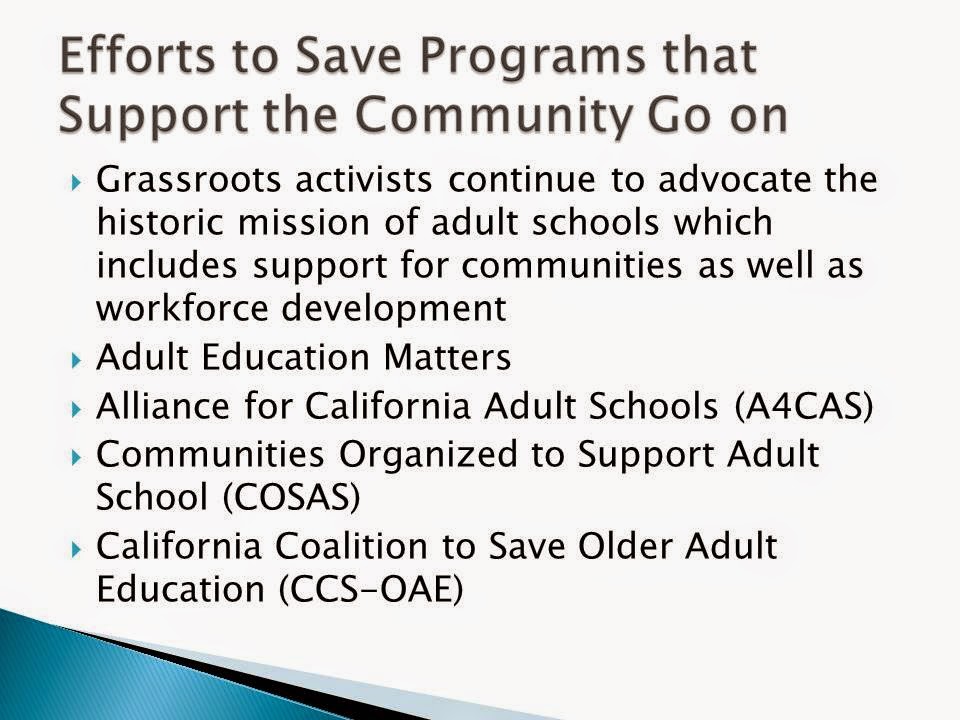
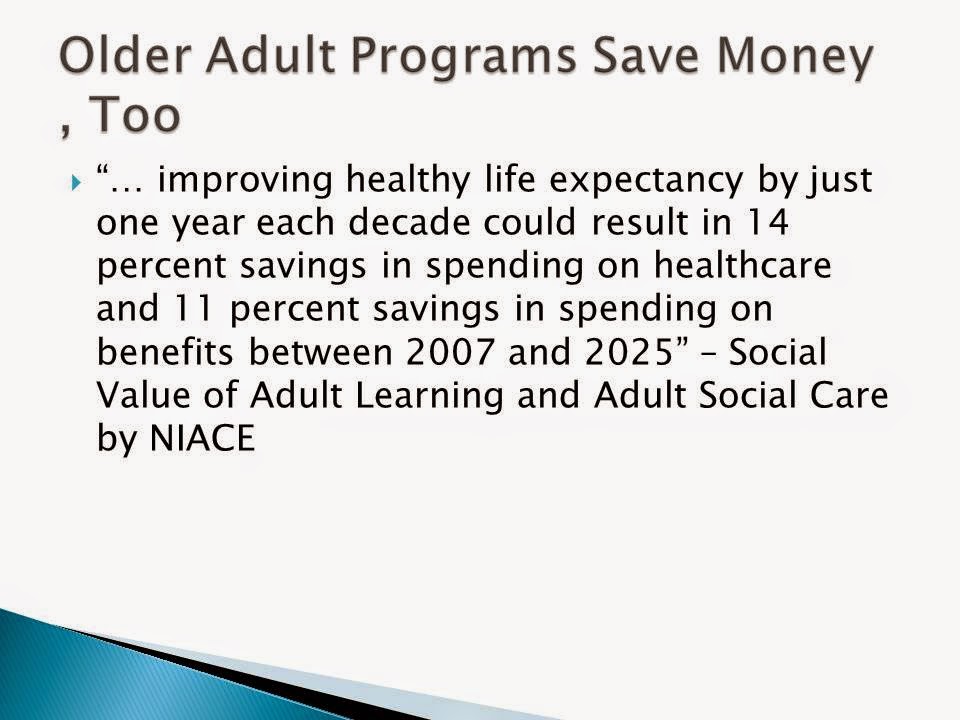
Historical context is what Kristen provided at our panel discussion. Kristen is a lead ESL teacher at West Contra Costa Adult School. She is a founding member of COSAS - Communities Organized to Support Adult Schools, a group that formed in response to the cuts six years ago and has met weekly since. She authors the Save Your Adult School blog, a priceless repository of facts and insight about Adult Education.
Click the link to see her powerpoint:
From left to right, Bruce Neuberger, George & Kristen Pursley Cynthia Eagleton
The Conference was deep and powerful. An AEM post on the conference is coming soon.
Cuts and reform in California Adult Education are part of a larger puzzle affecting every piece of Public Education in the US. To understand what is happening in Adult Education in California - and to influence it in a positive direction - we need to understand what is happening elsewhere - and we need historical context.
Historical context is what Kristen provided at our panel discussion. Kristen is a lead ESL teacher at West Contra Costa Adult School. She is a founding member of COSAS - Communities Organized to Support Adult Schools, a group that formed in response to the cuts six years ago and has met weekly since. She authors the Save Your Adult School blog, a priceless repository of facts and insight about Adult Education.
Public Education - Hallo sahabat fashion, Pada Artikel yang anda baca kali ini dengan judul Public Education, kami telah mempersiapkan artikel ini dengan baik untuk anda baca dan ambil informasi didalamnya. mudah-mudahan isi postingan
Artikel CCSF,
Artikel Community College,
Artikel Concerns,
Artikel Public Education,
Artikel Reform, yang kami tulis ini dapat anda pahami. baiklah, selamat membaca.
San Francisco and San Diego are often presented as models for how a Community College can (or should) deliver Adult Education.
What people often forget is that the Community College system, just like the K12 Adult School system and every other branch of public education, is undergoing reform. Models being held up as examples may in fact no longer exist - or won't exist for much longer. It is good to remember our role in this re-forming process. We have both the right and the responsibility to assess the changes as they are proposed and to speak up about what we think will best serve us as a people.
CCSF has credit ESL and non-credit ESL. The non-credit is what we generally call "Adult Education."
The CCSF Administration is for splitting it.
The CCSF Department Chairs are against splitting the ESL department.
I will provide more information as I get it. For now, here is a leaflet against splitting the department.
Save Community ESL!
CCSF management is proposing to split the ESL Department into two: ESL Community and ESL Vocational and Credit. This would effectively split ESL Noncredit into two pieces; part of noncredit would be under Community, and the other part of noncredit would be under Vocational and Academic. The reason being given is that two departments will be "more manageable" - rather than academically sound reasons such as excellent instruction, a viable program, and meeting real student needs.
Splitting the ESL Department in two is
DISRUPTIVE - The ESL Department once was divided into a noncredit "Centers" program and a credit program under the English Department. We have spent over a decade merging the two, and have achieved a seamless program that goes from Literacy to College Composition. Students move along this pathway at their own speed and have teachers who know the entire breadth of the program. Why would anyone want to disrupt this flow? Why would the college want to weaken the ESL program in this manner?
CONFUSING - How will students read the schedule? How will they enroll in courses in two different ESLs? How will they know the difference between the two? How would they enroll in a "Community" class at 8:00 a.m. and then a "Vocational" class at 10:00? Many do this effortlessly now. Moving from noncredit to credit is already daunting for students. This proposal would add yet another obstacle.
DAMAGING TO STUDENT PROGRESS - Students are now eligible for numerous certificates that include courses that, under this proposal, would be in two separate departments. Noncredit students are already not sufficiently aware of these certificates due to administration's failure to institute them since their inception in 2007. How would they earn certificates if they are split between two separate departments?
DISCRIMINATORY - The proposal to split ESL into "Community" and "Vocational and Academic" smacks of limiting the mission of City College to a degree and transfer mill. Relegating the largest part of noncredit to "Community" is a good way to make it easier to abandon these students in the near future. But the people who would be abandoned are the seniors, the recent immigrants, and those who have the least prior education - in other words, those who don't fit the current definition of "Student Success."
A whole and integrated ESL Department is
HIGH QUALITY - CCSF ESL is a central resource for San Francisco and its language minority inhabitants. If CCSF educates the workforce, ESL provides the support for non-native speakers to benefit from that training. Our minimum qualification for instructors, both credit and noncredit, is a Masters in Teaching English as a Second Language.
ACCESSIBLE - Students come first, and our mission is to serve them in ways that will serve them best, at convenient locations and times. We see students as whole human beings and provide them with the instruction they need no matter what the label. We do not differentiate from an administrative point of view: credit or noncredit; vocational or academic.
FOCUSED ON STUDENT PATHWAYS - Versatile instructors who move easily between credit and noncredit are the best student advocates for transition from noncredit to credit and noncredit to vocational certificate programs. One department ensures that students move from entry to goal in one straight line.
INCLUSIVE - CCSF ESL is open to all. Our mission includes all of the above: community, vocational, academic and several important goals that have not even been mentioned: skills focus, citizenship, bridge-to-vocational courses, and bridge-to-academic courses.
THIS IS AN IMMEDIATE THREAT - NEGOTIATIONS ARE PROCEEDING QUICKLY RIGHT NOW.
PLEASE CALL OR E-MAIL THE FOLLOWING RESPONSIBLE PARTIES AND TELL THEM TO STOP THE ATTACK ON COMMUNITY E.S.L.
Special Trustee with Extraordinary Powers Robert Agrella
“I spent most of my career” outsourcing jobs, said David Perdue, a business executive who’s running for Senate from Georgia in one of the closest-watched and tightest races in the nation. "This is a part of American business, part of any business. Outsourcing is the procurement of products and services to help your business run. People do that all day." He blames America’s jobs losses instead on “bad government policies: tax policy, regulation, even compliance requirements. It puts us at a competitive disadvantage with the rest of the world.”
They aren't only the shapers, of course. Grassroots groups, Teachers Unions, Legislators, Think Tanks, Academics, there are many. But these two groups definitely have an impact and they work on the national level, which is important.
More and more, things are flowing in a top down and federal sort of way - Common Core, College & Career Readiness, these are changes flowing from DC. California is and isn't embracing these changes. We are a big state with an economy stronger than most of the world's countries. California doesn't say yes to everything. It sometimes does things its own way and until the Crash of 2009, it had much stronger and better Adult Education than most states which it funded with its own money - unlike many states. All that in mind, it is still 1 of 50 states united under a Federal Government which has been changing public education in a number of significant ways. And where California isn't saying "yes" to changes suggested by the Federal Government, it's making its own changes. All in all, in California and everywhere else in these United States, public education is changing.
None of that, in and of itself, is good or bad. It is change. As always, we need to be awake to what is changing, look it over closely in light of the big picture, and then consider how the changes do or don't benefit our people. If and where we think the changes are beneficial, we need to nurture and encourage those changes. If and where we consider them harmful, we need to take steps to arrest the bad and begin the good.
Back to our story, the similarity of the names and acronyms - NCL and NCAL - makes it hard to remember which is which but it's important to try. They are different in some important ways. I won't try to detail the differences here. I'll doing so to my "List of One Hundred Posts I Need to Write."
National Commission on Adult Literacy - The Council grew out of two background assessment and planning projects carried out in early 2001. Funding for that work came from Harold W. McGraw, Jr., The Ford Foundation, and The Carnegie Corporation. One project assessed the status and lingering problems of adult literacy, following the work of the Business Council for Effective Literacy (BCEL); the other explored the feasibility of establishing a blue-ribbon commission on adult literacy. Both projects developed lengthy research and action agendas, and the rationale for them. CAAL was formed to build on that foundation, including the work of BCEL, its predecessor organization. Chairman of NCAL, David Perdue (Dollar General Literacy Foundation)
I created my own powerpoint on Adult Ed Reform for the Grassroots Summit last summer in June 2014 but have yet to post it on this blog.
On the one hand, I can see that a Dollar Store corporation would understand the struggles of people who, because of poverty, are very likely to shop at Dollar Stores. Poverty has a strong connection with lack of education. And yet, the fact that David Perdue, CEO of Dollar General, considers outsourcing something to be proud of... Wow, how does this work? How does outsourcing connect with a place to buy cheap stuff made by people working very hard jobs probably without a lot of work and safety rules connect with Adult Education? If you are providing people with a place to buy cheap stuff and you are sending jobs overseas, what kind of education might you suggest would be best for the country?
Who benefits? That was the question that drove my own powerpoint on Adult Ed Reform and I suppose at some point I should post it here.
In the meantime, I wanted to be sure you knew about Mr. Perdue.
You can put it in your "Things That Are Disturbing" file where it will hopefully compost into "Great Ideas For How to Increase Democracy and Public Engagement in Great Public Education."
I am sharing and analyzing the following 2011 Community College Academic Senate Resolution because I think it reveals a lot about how we've gotten to where we are now...
Hit the "read more" link to see and understand more...
to this place where we have a new system for delivering Adult Education - the Regional Consortia system which involves both K12 District Adult Schools and Community Colleges - but haven't decided how to fund that system.... and with no security for the K12 Adult Schools... even though they have done of the lion's share of delivering Adult Education since 1868.
It is important not only for the basic reason that if you have two groups mandated to do something - in this case, deliver Adult Education - but you fund only one of them or put only one of them in charge of the money, you can pretty much guarantee trouble...
but also because human beings are not only wonderful, insightful, generous, etc.
they are also greedy, manipulative, intentionally unfair, etc.
and even just... well meaning but with blind spots.
Me, too. That's just how we are.
That's why, when you are creating a structure for human beings - like a government - you have to build in checks and balances. You have to factor in the best people can do and the worst. You try to create something that brings out the best, puts a check on the worst, and if the worst does happen, has a way to deal with it.
You definitely don't do things like ask two groups to do something but only give one of them the funds to do it and/or put only one of them in charge.
The following resolution is old. It's from 2011. But I think it's very important that we look at it because it reveals something about how we've gotten here... and... I think it falls in the category of "humans not being their best selves." It's an example of how humans can manipulate information, presenting it in a way that benefits them but not the larger community.
While we were in the midst of dealing with chaos in our public education system... cuts to all branches and cost increases for colleges and universities...
K12 Adult Schools K12 Districts were presented as hostile to Adult Education in a resolution by the Academic Senate for California Community Colleges....
and it was recommended - by the Academic Senate for California Community Colleges - that Adult Ed be put in the Community College system. (The resolution is in full below and I will go through it, point by point.) Wow - Community Colleges saying that K12 Districts are basically bad places for Adult Ed to be and all Adult Ed should be put inside the Community College system. Wow. Why? Before we get into that, you might want to know: What's the Academic Senate for California Community College?
The Community College Academic Senate is basically the voice of Community College faculty for statewide policy. It's sort of like a really big student council but teachers and for the whole state. And just for Community Colleges.
(By the way, K12 Adult School teachers don't have one of these. Maybe it would have been helpful if we had. Something to think about.)
And then, you might want to know: What's a resolution?
It's a recommendation. That's basically it. A suggestion. It's not a law. It's not a bill that could become a law. It's a formal suggestion that people have thought about and talked about and voted on as their official position on something.
Okay, now we can get into it. Here's the 2011 resolution with my comments in italics:
Whereas, The responsibility for adult education in California is inconsistently applied throughout the state, in some cases being assumed by the K-12 system and in others by community colleges;
Whereas, The K-12 system has shifted millions of dollars in adult education funds to support other K-12 categorical programs that had experienced deep funding cuts, leading to a transfer of more than $400 million out of adult education programs;
(I'm not sure what they're talking about here. Most of the categoricals were flexed. A few were not. I will do my homework and find out which weren't. The Adult Ed money that was flexed and used by districts did not so much go to "support other categoricals" as simply go to keep K12 Districts going. All public education was under great stress. Adult Ed money might have gone to pay a teacher's salary or to buy books or to clean the cafeteria or to pay for school buses. Basically, it just kept public K12 schools going. A sad thing, yes. Sad that we that the whole financial collapse happened in the first place. Sad that public education has been struggling since Prop 13 and was finally brought to its knees by the financial collapse. But a bad thing that K12 schools survived? No. And if Adult Ed money had gone to prop up Community Colleges, I doubt the Academic Senate would have thought this was bad. But it didn't help Community Colleges. It helped K12 Schools.)
Whereas, The California Community Colleges Task Force on Student Success (established in response to Senate Bill 1143, Liu, 2010) draft recommendations (as of September 30, 2011) indicate that the State of California should develop a comprehensive strategy for addressing basic skills instruction, including providing for adult education; and
(Many people who work in Community Colleges are not happy with all the Task Force recommendations as you will see in this video:
I support the people in this video, by the way. I support their cause. I'm using the video to demonstrate a point: When it comes to these official recommendation things, people often pull out the parts they like and present them in isolation. When it works to their advantage, great, mention it. When it doesn't, protest the part you don't like separately. But don't present things in context. Don't look at and remind people of the whole. Again, I have nothing against the folks in this video. And they aren't the Academic Senate. I'm just pointing out that the Task Force Recommendations are complicated and folks in Community Colleges - teachers, admin, students - feel all kinds of ways about the various recommendations. I understand. Sometimes I like parts of something and don't like other parts. But if so, I need to be honest and state that somewhere. Otherwise, it's more or less "manipulating data" or in this case, recommendations. The Task Force Recommendations are their own big thing. They have had a huge impact. They are another big piece of the puzzle of Public Education changes. I am not going to try cover that piece here.) Whereas, California community colleges are best suited to provide adult education throughout the state but cannot properly fulfill this function due to budgetary constraints;
Okay, basically my response to this is "Says who?" I mean, really, who says that Community Colleges are best suited for delivering Adult Education? Okay, let's think about that for a minute. What has been everyone's feeling on who thinks Adult Ed should be delivered by Community Colleges - they do it best.... Some community colleges thought so - not all of them. The Governor thought so. That's a biggie. He's not "the people" but he's their leader and he's a strong leader who is not afraid of using his veto power plus he writes the budget. The LAO - Legislative Analyst Office - didn't think so. They recommended some changes - many of which I don't personally like. But they thought the two programs should continue on and they thought K12 Adult Schools should regain categorical status once the smoke of flex cleared. A lot of students and teachers and admin at K12 Adult Schools didn't think so. Some teachers and admin at K12 Adult Schools thought so because they didn't like their K12 Districts and how those districts were dealing with the economic downturn. I'm just going to come right out and say that some people - not all! - in LA thought Adult Ed would be better off in Community Colleges... and now that all this stuff is coming out about the ipad wheelings and dealings... maybe what the real trouble was and always is: K12 Districts which do things badly or have some corruption going on... create problems. Same thing is true of Community Colleges. Or Universities. Or anything! We are back to the truth that human beings are capable of both help and harm. Which is why it is good to have structures that account for both and encourage the former and discourage the latter. Because let's face it: crap happens. And as a third generation public school teacher and as a human being, I will tell you: Crap happens in schools. And in business. And in hospitals. And in homes. I mean, again... we are human beings! We're not nice all the time! But mostly... and I think I can be pretty safe in saying this because I have been working on all this for over 5 years now and over the course of that time, have talked to people around the state... mostly the K12 Adult School students and teachers and admin and surrounding communities liked their K12 Adult Schools. They just wanted them to have secure funding again. The problem was not the schools. The problem was the funding. And the funding connects back to that huge economic mess and one could even argue, goes all the way back to Prop 13. And that is why I don't like losing our broad mission. Because I think it is important to see ourselves as a community. And not think college and career readiness and money and business is the answer to every human problem. Business actually creates some problems. I mean, let's remember: Wall Street is a business! The people working there who made the decisions they made were very college and career ready! Life is not just about making money! Life is about the choices you make with the resources you have - including money, energy, people, intelligence, heart, etc. We are a river that needs two banks - and only one of them has dollars in it. Social emotional intelligence and health matters. Strong, resilient communities matter. They are part of what creates an economy that benefits the group and not just a very small portion of it. Did I digress? Yes and no. This whole thing - this whole adventure - is about reshaping Adult Education, which is a structure. And the only way you can build a good structure is to truly know what you are creating it for - to see the natural shape of something and then create a form which supports it in the healthiest and most beautiful way possible. So really... all this reshaping Adult Education... and all public education... is about how we see ourselves. That's the truth and it's not said out loud real often. But it's the truth. We are arguing about who and what we are... a vision shaped by our own perceptions... perceptions colored by our capacity and character... Are we willing and able to see things we don't like? Are we willing and able to see things that are painful to realize or address? Are we willing and able to see solutions which might not be of great benefit to us personally or to ourselves, alone? Are we willing and able to share what we see with others? Publically? Are we willing to take the heat for speaking up when others fear to? Are we willing to speak up for something which might be reviled? Are we willing to advocate for people the larger culture ignores or denies or rejects? Are we willing to put forth solutions which might be rejected? All these questions - and of course, their answers - shape we're going as a people. Our personal decisions to see or not see... speak or not speak... shape our collective future.
Back to what Brown sees as a solution... Brown didn't support Prop 13 and he didn't flex categoricals. Previous administrations did both. He was left holding the hot potato.
And when given a hot potato, what do most people want to do with it? Pass it on!
It's hard to sit with a problem you did not create and try to tease out what caused the problem and then slowly and wisely think through what solutions might solve it.
I think "give Adult Ed to the Community Colleges" is a hot potato solution. It sounds good. But it doesn't really solve the problem. It doesn't even just pass it on. It actually makes things worse. But... again... human beings! We don't always think things through. (Me, too!)
Resolved, That the Academic Senate for California Community Colleges recommend that the Board of Governors urge the Legislature to assign responsibility for adult education to the California community colleges but only if sufficient funding to address this mission is provided.
Lessons and questions: 1. What weight did this have with people? With Legislators? With the Governor? With various agencies and commissions and so forth? It obviously did not have a lot of weight with the LAO because the LAO recommended the opposite. The LAO also pushed for narrowing the mission... something mirrored in the Task Force recommendations for the Community College system also... the whole push for College and Career Readiness versus "community"... which mostly, CC folks are not happy about... My takeaway: The resolution probably had some weight. They thought about things. They came to a decision about what they wanted. They spoke up. Speaking up is good. But other people also thought about things and many said, "No. We don't agree with you." 2. Why the heck did they think they could say that Community Colleges are "best suited"? Can you just say that something is best suited without real proof? What did they base on that on? It always boggles my mind how people can be so bold. On the other hand, being bold has its benefits. In any case, I disagree with them. As do many people. Some of whom I disagree with on many other points! I always love what CDE Superintendent Tom Torlakson said about the whole put Adult Ed inside Community Colleges thing: "If it ain't broke, don't fix it!" Thank you, Tom. 3. Ideas are the beginning of everything. Never think that your idea doesn't matter. It matters. A lot. Really, we're all just operating on a lot of collective ideas - yes, that and gravity, and water and oxygen and rocks and plants and animals, I know. There are "real" things. But if we were all operating on just "real" things, then human culture would be the same across time and space. And it isn't. Because our ideas... what we decide matters.. our perceptions... change. A good idea... a timely idea... well expressed... can change everything. It just takes time - and energy. But that's where everything begins. 4. That's why I think it's so important to really think about these things. Education is the hand that rocks the cultural cradle. We're reshaping public education. Okay. But how? Who is that baby in the cradle? What sort of people do we want them to grow up to be? Education - how much, how little, for whom, to what purpose - shapes our future. What do we want? When we look into the future, what do we see? Who's doing the looking and what shapes how they see things? What's the past of the people shaping the future? A lot of "I's" shape a we. Past, present, and future - who are they? And what do they see?
K12 Adult Education needs a stable source of funding separate from the community college system.
Within the Regional Consortia system, both Community Colleges and K12 Adult Schools are mandated to provide Adult Education, but only Community Colleges have secure funding. And they will continue to have secure funding because their funding exists independent of the Regional Consortia system. They have apportionment (this is what their funding is called). They are secure. On top of their apportionment money, they may get extra money for Adult Education - which may come in through the Community College Chancellor's Office.
K12 Adult Schools are not secure. K12 Adult Schools are not safe. K12 Adult Schools have been mandated to do a job but haven't been given the means to do the job and can't properly prepare to do it, given the fact they don't know what the future holds.
This is the plain truth.
It is a also a truth some folks have danced around when asked to explain how K12 Adult Schools can survive this challenge. And it is a truth that has sometimes created division amongst Adult Ed advocates in their desperation to figure out a way to save K12 Adult Schools.
It is not, however, a truth which K12 Adult Schools or their advocates created.
It is just a truth they must face... that K12 Adult Schools, themselves, need stabilizing if they are to continue on as the stabilizing fourth leg of California's Public Education system.
In what form that stability will come - a return to categorical status, some new form of dedicated funding specific to K12 Adult Schools, or some other way - we don't know.
We just know if it doesn't happen, more K12 Adult Schools will collapse, which will destabilize our public education system, economy, and social stability.
This December 2012 Edsource article provides helpful information. I've highlighted the section with quotes from Paul Steenhausen, who wrote the LAO Report.
California’s Legislative Analyst’s Office says the state’s embattled adult education system needs a dedicated and permanent funding stream that can’t be appropriated for other school programs when the state budget goes south. Restructuring California’s Adult Education System calls for the state Legislature to restore adult education as a categorical program. Adult Ed advocates lauded the proposal, even though it relies on funding that is speculative and requires a commitment from legislators and Gov. Jerry Brown that they have so far not shown. Adult schools are an important strand in the state’s safety net, offering community-based classes to some of the state’s neediest adults, ranging from the unemployed, the disabled and the elderly to ex-offenders reentering society, immigrants trying to learn English and become citizens, and high school dropouts seeking to earn their GEDs.
Until the 2008-09 academic year, adult education was funded through one of the dozens of categorical programs that could be used only for their stated purpose. But as part of the February 2009 state budget plan, legislators approved what’s known as “categorical flex,” giving school districts the authority to use funds from 40 categorical programs, including adult education, for any educational purpose. Chris Nelson, State President of the California Council for Adult Education. Photo courtesy CCAE. (Click to enlarge)The LAO report says that move signaled “adult schools’ lower priority within the K-12 system.” Since then, local school boards have funneled as much as 70 percent of statewide adult ed funds to support K-12 programs, according to Chris Nelson, president of the California Council for Adult Education.
At least 35 programs have shut down as a result, and many of the 300 remaining programs are operating on shoestring budgets. Altogether, the LAO estimates that in 2011-12, the state and federal governments spent about $400 million on district-run adult schools, down from $854 million before flex started.
Many community colleges also offer adult education classes, spending about $1.7 billion last year, according to the LAO, but the colleges take that money from their regular state funding and not from separate categorical accounts.
Categorical flex is due to expire at the end of the 2014-15 school year, and the LAO is recommending that starting in 2015-16 adult education be restored as a categorical program with a dedicated funding stream. The program is a good candidate for restoration of funds, said Paul Steenhausen, who wrote the LAO report, because it reaches a distinct, underserved population.
“Adult education is a different animal,” Steenhausen said. Because it doesn’t serve K-12 students, it is “fundamentally different from other categoricals.”
However, many observers believe that the current level of flexible funding will continue beyond 2014-15 unless Gov. Brown convinces the Legislature to reconfigure the school finance system using a weighted student formula (WSF). Under this approach, money would follow the student, so schools enrolling students with greater needs, such as English learners and those from low-income families, would receive more funds. When Gov. Brown first proposed WSF last January, he didn’t support separate funding for adult education, leading advocates to oppose it.
Even the recent passage of Proposition 30, which increases funding to schools through a combination of a small sales tax increase and higher income taxes on the wealthiest Californians, has not revived support for adult education, according to Nelson.
“We’re still hearing that programs are being threatened with being cut more,” Nelson said. “I have not heard of anybody who has said they’re going to get an increase because of Prop. 30.” Roadmap to restructuring Adult Ed, California Legislative Analyst’s Office. (Click to enlarge)Instead, Nelson said he believes that school districts will be under pressure to use increased revenues to provide raises for teachers. “We’re all fighting for every little dollar, and it’s unfortunate how this has played out – one program against another.”
Nelson described the situation in Sonoma County, which had 11 adult education schools a few years ago, but has only one remaining program, in Petaluma. That program is being inundated by prospective students from all over the county. Nelson expects that Petaluma, which doesn’t have the capacity to serve so many people, will soon have to restrict its program to city residents.
One reason adult education may lack support from some legislators is the program’s uneven distribution across the state. Adult ed schools are more common in urban than rural communities. The LAO report addresses this issue. The LAO is predicting that as the economy improves, the state will soon be receiving more funds that must be spent on K-14 education. The report recommends that some of this new money should be allocated to adult education based on regional needs and the ability of districts, colleges and local businesses to work as a team to avoid duplication of services and provide smooth pathways for students to jobs and college. The LAO also recommends that funding be allocated based on student outcomes – such as how many successfully complete courses – the way federal funds are now distributed.
But, finally, “the bigger issue is how is adult ed going to get funded,” Nelson said. “The LAO does recommend designated funding for adult ed, and that’s very key.”
Going deeper
At Risk: Adult Schools in California, EdSource, June 2012 California Council for Adult Education Restructuring California’s Adult Education System, Legislative Analyst’s Office, Dec. 5, 2012 Video: Paul Steenhausen, LAO principal fiscal and policy analyst and author of adult ed report, discusses the findings and recommendations.
The December 2012 LAO - Legislative Analyst Office - Report on Adult Education has served in many ways as a template for reform in Adult Education.
K12 Adult Education needs a stable source of funding separate from the community college system.
Within the Regional Consortia system, both Community Colleges and K12 Adult Schools are mandated to provide Adult Education, but only Community Colleges have secure funding. And they will continue to have secure funding because their funding exists independent of the Regional Consortia system. They have apportionment (this is what their funding is called). They are secure. On top of their apportionment money, they may get extra money for Adult Education - which may come in through the Community College Chancellor's Office.
K12 Adult Schools are not secure. K12 Adult Schools are not safe. K12 Adult Schools have been mandated to do a job but haven't been given the means to do the job and can't properly prepare to do it, given the fact they don't know what the future holds.
This is the plain truth.
It is a also a truth some folks have danced around when asked to explain how K12 Adult Schools can survive this challenge. And it is a truth that has sometimes created division amongst Adult Ed advocates in their desperation to figure out a way to save K12 Adult Schools.
It is not, however, a truth which K12 Adult Schools or their advocates created.
It is just a truth they must face... that K12 Adult Schools, themselves, need stabilizing if they are to continue on as the stabilizing fourth leg of California's Public Education system.
In what form that stability will come - a return to categorical status, some new form of dedicated funding specific to K12 Adult Schools, or some other way - we don't know.
We just know if it doesn't happen, more K12 Adult Schools will collapse, which will destabilize our public education system, economy, and social stability.
This December 2012 Edsource article provides helpful information. I've highlighted the section with quotes from Paul Steenhausen, who wrote the LAO Report.
California’s Legislative Analyst’s Office says the state’s embattled adult education system needs a dedicated and permanent funding stream that can’t be appropriated for other school programs when the state budget goes south. Restructuring California’s Adult Education System calls for the state Legislature to restore adult education as a categorical program. Adult Ed advocates lauded the proposal, even though it relies on funding that is speculative and requires a commitment from legislators and Gov. Jerry Brown that they have so far not shown. Adult schools are an important strand in the state’s safety net, offering community-based classes to some of the state’s neediest adults, ranging from the unemployed, the disabled and the elderly to ex-offenders reentering society, immigrants trying to learn English and become citizens, and high school dropouts seeking to earn their GEDs.
Until the 2008-09 academic year, adult education was funded through one of the dozens of categorical programs that could be used only for their stated purpose. But as part of the February 2009 state budget plan, legislators approved what’s known as “categorical flex,” giving school districts the authority to use funds from 40 categorical programs, including adult education, for any educational purpose. Chris Nelson, State President of the California Council for Adult Education. Photo courtesy CCAE. (Click to enlarge)The LAO report says that move signaled “adult schools’ lower priority within the K-12 system.” Since then, local school boards have funneled as much as 70 percent of statewide adult ed funds to support K-12 programs, according to Chris Nelson, president of the California Council for Adult Education.
At least 35 programs have shut down as a result, and many of the 300 remaining programs are operating on shoestring budgets. Altogether, the LAO estimates that in 2011-12, the state and federal governments spent about $400 million on district-run adult schools, down from $854 million before flex started.
Many community colleges also offer adult education classes, spending about $1.7 billion last year, according to the LAO, but the colleges take that money from their regular state funding and not from separate categorical accounts.
Categorical flex is due to expire at the end of the 2014-15 school year, and the LAO is recommending that starting in 2015-16 adult education be restored as a categorical program with a dedicated funding stream. The program is a good candidate for restoration of funds, said Paul Steenhausen, who wrote the LAO report, because it reaches a distinct, underserved population.
“Adult education is a different animal,” Steenhausen said. Because it doesn’t serve K-12 students, it is “fundamentally different from other categoricals.”
However, many observers believe that the current level of flexible funding will continue beyond 2014-15 unless Gov. Brown convinces the Legislature to reconfigure the school finance system using a weighted student formula (WSF). Under this approach, money would follow the student, so schools enrolling students with greater needs, such as English learners and those from low-income families, would receive more funds. When Gov. Brown first proposed WSF last January, he didn’t support separate funding for adult education, leading advocates to oppose it.
Even the recent passage of Proposition 30, which increases funding to schools through a combination of a small sales tax increase and higher income taxes on the wealthiest Californians, has not revived support for adult education, according to Nelson.
“We’re still hearing that programs are being threatened with being cut more,” Nelson said. “I have not heard of anybody who has said they’re going to get an increase because of Prop. 30.” Roadmap to restructuring Adult Ed, California Legislative Analyst’s Office. (Click to enlarge)Instead, Nelson said he believes that school districts will be under pressure to use increased revenues to provide raises for teachers. “We’re all fighting for every little dollar, and it’s unfortunate how this has played out – one program against another.”
Nelson described the situation in Sonoma County, which had 11 adult education schools a few years ago, but has only one remaining program, in Petaluma. That program is being inundated by prospective students from all over the county. Nelson expects that Petaluma, which doesn’t have the capacity to serve so many people, will soon have to restrict its program to city residents.
One reason adult education may lack support from some legislators is the program’s uneven distribution across the state. Adult ed schools are more common in urban than rural communities. The LAO report addresses this issue. The LAO is predicting that as the economy improves, the state will soon be receiving more funds that must be spent on K-14 education. The report recommends that some of this new money should be allocated to adult education based on regional needs and the ability of districts, colleges and local businesses to work as a team to avoid duplication of services and provide smooth pathways for students to jobs and college. The LAO also recommends that funding be allocated based on student outcomes – such as how many successfully complete courses – the way federal funds are now distributed.
But, finally, “the bigger issue is how is adult ed going to get funded,” Nelson said. “The LAO does recommend designated funding for adult ed, and that’s very key.”
Going deeper
At Risk: Adult Schools in California, EdSource, June 2012 California Council for Adult Education Restructuring California’s Adult Education System, Legislative Analyst’s Office, Dec. 5, 2012 Video: Paul Steenhausen, LAO principal fiscal and policy analyst and author of adult ed report, discusses the findings and recommendations.
This post is directly primarily to my colleagues in Adult Ed but the blogs listed (about halfway down the page) are recommended for all.
A lot is going on in the world of education.
Two big teachers unions - the National Education Association and the American Federation of Teachers have been debating Common Core, the head of the US Department of Education, charter schools, diversity in the teaching side of the classroom (it's far less than the class side for those who don't know), tenure, the Vergara decision, and a number of other things. Many of their debates were public and all of their resolutions are. You can read about NEA's call for Head Fed Ed Arne Duncan to resign here and AFT's call for him to submit to "improvement plan" or resign here. You can see lots of the debates on the union websites and You tube including this speech by Rev William Barber:
Clearly, change is afoot in teachers unions. And by afoot, I mean from the ground up, with calls for change not just in US administration and policy but union administration and policy, as well.
Note: Many Adult Ed teachers, like myself, belong to CFT - the California Federation of Teachers - which is a branch of AFT. In Los Angeles, the biggest Adult School in California, teachers belong to UTLA which is part of both AFT/CFT and NEA/CTA.
Were those enough letters or did you want more alphabet soup?
Meanwhile, those of us in Adult Ed, especially in California, especially in K12 Adult Schools, have been focusing all on our energy on survival.
This is understandable.
What we need to remember, however, as we organize within and between schools and programs, push for student and teacher inclusion in the Regional Consortia planning process, email and visit legislators, and ask the Governor and the Department of Finance for stable K12 Adult School funding...
is the connection between what is happening in Adult Ed in California, especially K12 Adult Schools, and what is happening in education all across the country.
If we don't, we either won't succeed, or we'll succeed in the short run but fail in the long.
We must see and understand the changes in how education is funded, what is taught, what is valued, who is valued, and who does and doesn't benefit from these changes.
This makes things twice as hard for us as for other branches of education. It also makes it twice as clear that we need to be aware and speak up about what we know to be true because we have twice as much riding on it. Our programs are not just at risk of being hugely altered, they are at risk of being eliminated. Which it makes it doubly important that we bring news of this to the larger community because without knowledge of what is happening in Adult Ed, the folks in the other branches of Public Education may never see the full and larger picture. We are the missing piece.
Yes, it's hard.
Life is hard, sometimes.
In fact, mostly, on this planet, it has been... and still is for a good number of the people riding on it.
Sometimes I ponder how we are the branch of public education charged with teaching citizenship.
If we are not willing to practice responsible citizenship, which includes participation in democracy, what gives us the right to teach it?
We are also the branch of public education charged with teaching the folks with the most hurdles to get over - barriers of language, poverty, dis/ability, literacy, resources, etc.
If we, ourselves, are not willing to leap a few hurdles... to risk overwhelm, injury, or failure in the trying... what gives us the right to ask others to do so?
Yes, we can speak English and teach English. But does that gives us the right to ask someone to try harder than we're willing to?
At some point, we in Adult Education have to ask ourselves: What are we teaching and why?
Many in Adult Ed teach immigrants. We teach ESL, Family Literacy, Job Skills, and Citizenship.
Why?
Because we "believe in" democracy and the "American Way"?
Because we care about our students, see their struggles, and want to give them tools to succeed here? But only so far - not so far as to ourselves actually engage in real citizenship, real democracy, real understanding of the world and how it works or to encourage our students to do the same?
Because we like the backwater nature of our jobs, out of the fray of K12, with a little more freedom, a little less structure, a little more humanity - until we're asked to give something more of ourselves than teaching... until we're asked to take the same sort of risks we ask our students to take... to challenge ourselves, exercise self-discipline, and put into practice what we know will make things better?
I say again: Yes, this is hard.
It takes effort. Risks must be taken and mistakes may be made. At times we may feel overwhelmed, frustrated, discouraged, angry, tired, confused, and scared - the same way Adult Ed students sometimes feel as they pursue their GEDs and High School Diplomas, learn English, master new job skills, and become citizens.
The same way anyone doing anything of real worth feels as they move through discomfort and into the deep joy of meaningful accomplishment.
It's all scary, unknown, and what could ultimately save us.
It's also not the first time humans have taken risks to make things better and we're not in this all alone. There are many of us of working to save and rebuild Adult Ed. Many of us working to save and strengthen Public Education. And many more of us who can do so.
To show us more of the bigger picture so that we can see where we fit in it, here are some blogs by writers focusing more on the K12 side of things. I've pulled quotes from some of them and I've added a few comments.
1. Mercedes Schneider's blog Deutsch29. Mercedes teaches school by day and at night apparently never sleeps because her blog is gobstoppingly amazing. Research research and more research. Every i is dotted and t's are crossed.
The following post is in response to the discussion about Common Core at the AFT Convention. Remember that Adult Ed is also going Common Core. Already there are workshops at CCAE and Catesol Conferences about how to teach ESL the Common Core way. And the GED is now Common Core. And the GED being used in most of California (but not Los Angeles!) is the Pearson version. It costs more and it certainly makes Pearson a few bucks. As in many. Here's the post:
And here's a quote to consider with my highlights:
So, to those teachers who are tempted to take AFT money in order to “”make CCSS better,” let me caution you that your work will become part of the CCSS that is ultimately locked into place and handed over to the likes of Pearson for nationwide marketing purposes. Pearson plans to make itself indispensable and benefit handsomely from CCSS by offering assessments, curriculum to accompany those assessments, teacher development, and “data driven adaptive learning.” Imagine how much better it will be for Pearson to be able to advertise that CCSS was “rewritten by teachers.” That is a phenomenal selling point, not only for Pearson, but also for any influential, pro-CCSS individual taking to the cameras.
2. Anthony Cody's blog Living in Dialogue. Anthony taught middle school science in Oakland for many years. He started the Network for Public Education with Diane Ravitch.
In this post, Common Core-Aligned Tests and the New Pearson GED: Failure By Design?, he discusses Pearson and the new GED.
So the key is that those who design the tests are making an intentional decision regarding how many students pass or fail. A 30% pass rate on Common Core tests is not some objective statement regarding how many students are ready for career and college. It is a predetermined outcome, which has a whole set of assumptions in it regarding what "college and career ready" means.
3. Jose Luis Vilson's blog The Jose Vilson. Jose teaches math in New York city. He addresses many issues in his blog including issues of race, class, and gender. This is a topic often left out of discussions about Adult Education even though race, class, and gender has a great deal to do with who is in our classrooms and why and who will be there in the future and what is taught to them and why. Never forget that California is the 8th largest economy in the world. Whatever happens here, someone, somewhere, is making money. California is a "majority-minority" state with Latinos outnumbering whites. Issues of race, class, and gender make it all the more important that student voice is included in planning the new Regional Consortia. Students reflect the reality of who California is and is becoming far more than admin or teachers do.
4. Professor Vasquez Heileg's blog Cloaking Inequality. Prof JVH was at the University of Texas at Austin but is now on his way to Sacramento where he will be a Full Professor and Director of the Educational Leadership at California State at Sacramento. It was at the panel on Research and Advocacy at the Network for Public Education conference in Austin, that I learned from Prof JVH why there is often muted, mumbled, or absolutely no outcry from academics on what is happening to public education. Just as we in Adult Education fear reprisal or job loss for speaking up about what is happening in Adult Ed, so do the folks in higher ed. I don't know why I thought it would be any different. We're talking about human beings here. Yes, there are "rules." Yes, there is free speech, tenure, and an agreed on value for the "truth." But what actually happens is often a different story.
You can read the blog post that was the basis for his remarks at the NPE panel here:
Prof JVH's wisdom did something else for me: It made me hopeful. If Prof JVH can be truthful about what is happening in Public Education, so can other academics. Maybe academics focused on Adult Education. It would be hugely helpful if they did so.
In the meantime, I can be truthful.
Like those silent academics, I fear rebuff and reprisal.
I also know if I'm not willing not to speak... if I'm not willing to take a risk and share what I know and see... If I'm not willing to work as hard as I ask my students to work... If I'm not willing to risk rejection, failure, and fear...
not only do I not have the right to ask my students to take such risks...
I don't have the right to expect anything to change for the better - for Adult Ed, for Public Ed, for me.
Things really are at a crisis point in Public Education - especially in Adult Education.
That doesn't mean everything will end badly.
Crisis, as we all know, is opportunity.
But it does mean that if I want a good outcome, I need to make an effort for one.
I need to think toward it, risk toward it, work toward it.
Change includes me.
This post is directly primarily to my colleagues in Adult Ed but the blogs listed (about halfway down the page) are recommended for all.
A lot is going on in the world of education.
Two big teachers unions - the National Education Association and the American Federation of Teachers have been debating Common Core, the head of the US Department of Education, charter schools, diversity in the teaching side of the classroom (it's far less than the class side for those who don't know), tenure, the Vergara decision, and a number of other things. Many of their debates were public and all of their resolutions are. You can read about NEA's call for Head Fed Ed Arne Duncan to resign here and AFT's call for him to submit to "improvement plan" or resign here. You can see lots of the debates on the union websites and You tube including this speech by Rev William Barber:
Clearly, change is afoot in teachers unions. And by afoot, I mean from the ground up, with calls for change not just in US administration and policy but union administration and policy, as well.
Note: Many Adult Ed teachers, like myself, belong to CFT - the California Federation of Teachers - which is a branch of AFT. In Los Angeles, the biggest Adult School in California, teachers belong to UTLA which is part of both AFT/CFT and NEA/CTA.
Were those enough letters or did you want more alphabet soup?
Meanwhile, those of us in Adult Ed, especially in California, especially in K12 Adult Schools, have been focusing all on our energy on survival.
This is understandable.
What we need to remember, however, as we organize within and between schools and programs, push for student and teacher inclusion in the Regional Consortia planning process, email and visit legislators, and ask the Governor and the Department of Finance for stable K12 Adult School funding...
is the connection between what is happening in Adult Ed in California, especially K12 Adult Schools, and what is happening in education all across the country.
If we don't, we either won't succeed, or we'll succeed in the short run but fail in the long.
We must see and understand the changes in how education is funded, what is taught, what is valued, who is valued, and who does and doesn't benefit from these changes.
This makes things twice as hard for us as for other branches of education. It also makes it twice as clear that we need to be aware and speak up about what we know to be true because we have twice as much riding on it. Our programs are not just at risk of being hugely altered, they are at risk of being eliminated. Which it makes it doubly important that we bring news of this to the larger community because without knowledge of what is happening in Adult Ed, the folks in the other branches of Public Education may never see the full and larger picture. We are the missing piece.
Yes, it's hard.
Life is hard, sometimes.
In fact, mostly, on this planet, it has been... and still is for a good number of the people riding on it.
Sometimes I ponder how we are the branch of public education charged with teaching citizenship.
If we are not willing to practice responsible citizenship, which includes participation in democracy, what gives us the right to teach it?
We are also the branch of public education charged with teaching the folks with the most hurdles to get over - barriers of language, poverty, dis/ability, literacy, resources, etc.
If we, ourselves, are not willing to leap a few hurdles... to risk overwhelm, injury, or failure in the trying... what gives us the right to ask others to do so?
Yes, we can speak English and teach English. But does that gives us the right to ask someone to try harder than we're willing to?
At some point, we in Adult Education have to ask ourselves: What are we teaching and why?
Many in Adult Ed teach immigrants. We teach ESL, Family Literacy, Job Skills, and Citizenship.
Why?
Because we "believe in" democracy and the "American Way"?
Because we care about our students, see their struggles, and want to give them tools to succeed here? But only so far - not so far as to ourselves actually engage in real citizenship, real democracy, real understanding of the world and how it works or to encourage our students to do the same?
Because we like the backwater nature of our jobs, out of the fray of K12, with a little more freedom, a little less structure, a little more humanity - until we're asked to give something more of ourselves than teaching... until we're asked to take the same sort of risks we ask our students to take... to challenge ourselves, exercise self-discipline, and put into practice what we know will make things better?
I say again: Yes, this is hard.
It takes effort. Risks must be taken and mistakes may be made. At times we may feel overwhelmed, frustrated, discouraged, angry, tired, confused, and scared - the same way Adult Ed students sometimes feel as they pursue their GEDs and High School Diplomas, learn English, master new job skills, and become citizens.
The same way anyone doing anything of real worth feels as they move through discomfort and into the deep joy of meaningful accomplishment.
It's all scary, unknown, and what could ultimately save us.
It's also not the first time humans have taken risks to make things better and we're not in this all alone. There are many of us of working to save and rebuild Adult Ed. Many of us working to save and strengthen Public Education. And many more of us who can do so.
To show us more of the bigger picture so that we can see where we fit in it, here are some blogs by writers focusing more on the K12 side of things. I've pulled quotes from some of them and I've added a few comments.
1. Mercedes Schneider's blog Deutsch29. Mercedes teaches school by day and at night apparently never sleeps because her blog is gobstoppingly amazing. Research research and more research. Every i is dotted and t's are crossed.
The following post is in response to the discussion about Common Core at the AFT Convention. Remember that Adult Ed is also going Common Core. Already there are workshops at CCAE and Catesol Conferences about how to teach ESL the Common Core way. And the GED is now Common Core. And the GED being used in most of California (but not Los Angeles!) is the Pearson version. It costs more and it certainly makes Pearson a few bucks. As in many. Here's the post:
And here's a quote to consider with my highlights:
So, to those teachers who are tempted to take AFT money in order to “”make CCSS better,” let me caution you that your work will become part of the CCSS that is ultimately locked into place and handed over to the likes of Pearson for nationwide marketing purposes. Pearson plans to make itself indispensable and benefit handsomely from CCSS by offering assessments, curriculum to accompany those assessments, teacher development, and “data driven adaptive learning.” Imagine how much better it will be for Pearson to be able to advertise that CCSS was “rewritten by teachers.” That is a phenomenal selling point, not only for Pearson, but also for any influential, pro-CCSS individual taking to the cameras.
2. Anthony Cody's blog Living in Dialogue. Anthony taught middle school science in Oakland for many years. He started the Network for Public Education with Diane Ravitch.
In this post, Common Core-Aligned Tests and the New Pearson GED: Failure By Design?, he discusses Pearson and the new GED.
So the key is that those who design the tests are making an intentional decision regarding how many students pass or fail. A 30% pass rate on Common Core tests is not some objective statement regarding how many students are ready for career and college. It is a predetermined outcome, which has a whole set of assumptions in it regarding what "college and career ready" means.
3. Jose Luis Vilson's blog The Jose Vilson. Jose teaches math in New York city. He addresses many issues in his blog including issues of race, class, and gender. This is a topic often left out of discussions about Adult Education even though race, class, and gender has a great deal to do with who is in our classrooms and why and who will be there in the future and what is taught to them and why. Never forget that California is the 8th largest economy in the world. Whatever happens here, someone, somewhere, is making money. California is a "majority-minority" state with Latinos outnumbering whites. Issues of race, class, and gender make it all the more important that student voice is included in planning the new Regional Consortia. Students reflect the reality of who California is and is becoming far more than admin or teachers do.
4. Professor Vasquez Heileg's blog Cloaking Inequality. Prof JVH was at the University of Texas at Austin but is now on his way to Sacramento where he will be a Full Professor and Director of the Educational Leadership at California State at Sacramento. It was at the panel on Research and Advocacy at the Network for Public Education conference in Austin, that I learned from Prof JVH why there is often muted, mumbled, or absolutely no outcry from academics on what is happening to public education. Just as we in Adult Education fear reprisal or job loss for speaking up about what is happening in Adult Ed, so do the folks in higher ed. I don't know why I thought it would be any different. We're talking about human beings here. Yes, there are "rules." Yes, there is free speech, tenure, and an agreed on value for the "truth." But what actually happens is often a different story.
You can read the blog post that was the basis for his remarks at the NPE panel here:
Prof JVH's wisdom did something else for me: It made me hopeful. If Prof JVH can be truthful about what is happening in Public Education, so can other academics. Maybe academics focused on Adult Education. It would be hugely helpful if they did so.
In the meantime, I can be truthful.
Like those silent academics, I fear rebuff and reprisal.
I also know if I'm not willing not to speak... if I'm not willing to take a risk and share what I know and see... If I'm not willing to work as hard as I ask my students to work... If I'm not willing to risk rejection, failure, and fear...
not only do I not have the right to ask my students to take such risks...
I don't have the right to expect anything to change for the better - for Adult Ed, for Public Ed, for me.
Things really are at a crisis point in Public Education - especially in Adult Education.
That doesn't mean everything will end badly.
Crisis, as we all know, is opportunity.
But it does mean that if I want a good outcome, I need to make an effort for one.
I need to think toward it, risk toward it, work toward it.

 At the 2015 Network for Public Education Conference in Chicago, Kristen Pursley, Bruce Neuberger, and I presented a panel entitled, "The Battle for Adult Education."