Tampilkan postingan dengan label AB86. Tampilkan semua postingan

Selasa, 11 Agustus 2015

adult history Some Advice from CCAE - japraklupo

AB86 - Hallo sahabat fashion, Pada Artikel yang anda baca kali ini dengan judul AB86, kami telah mempersiapkan artikel ini dengan baik untuk anda baca dan ambil informasi didalamnya. mudah-mudahan isi postingan Artikel AB86, Artikel CCAE, Artikel K-12 Adult Ed, Artikel MOC, Artikel MOE, yang kami tulis ini dapat anda pahami. baiklah, selamat membaca.

Judul : adult history Some Advice from CCAE - japraklupo
link : adult history Some Advice from CCAE - japraklupo

Baca juga


AB86

This was sent out August 8, 2015 to CCAE members:
Some Advice from CCAE
As some of you might have noticed the previous message was sent out last year.

(Note from Cynthia:  I deleted the post from this blog.) 

Seems like the important issues then are still the important issues now. Below is updated advice on MOE vs MOC which should be relevant to your current consortia conversations.As Adult Schools move into challenging conversations with our consortia partners we in CCAE realize that if we are to be successful providers of adult education services in this new world we must be successful within our consortia. As such CCAE will be providing advisories that are intended to give the best advice from state leaders of Adult Education within our organization. These advisories are not intended to represent state policy or Ed Code but rather guidance based on the most current information (laws and policies) available and best Adult Ed practices within the state. Our goal is to inform our members of options and recommendations that will ultimately provide the best services for our students and the best return on investment for our state.
MOE is NOT MOC (Maintenance of Effort is NOT Maintenance of Capacity)

Hit the "read more" link to learn more.

Although we worked successfully with and were appreciative of the Governor, Department of Finance and Legislature agreeing to help maintain the capacity of a fragile Adult Education system and providing K12 specific funding for such maintenance, it is important for all of us to keep in mind that the way Maintenance of Effort was determined based on expenditures in 2012-13 resulted in an actual DECREASE in true dollars for Adult Schools and could ultimately result in the erosion of capacity within our Adult Ed system. Specifically, the MOE calculation did not take into account increased costs over the last two years related to STRS, COLAs, salaries, and health care.  With this loss of revenue and the inability to charge fees for ESL, each Adult School will inevitably have to consider reducing programs and services if the costs are not addressed in some way.
So what should an Adult School do?
Since the MOE funding amounts per school district have already been determined, the remaining funds of the $500 million Adult Education Block Grant (AEBG) will be distributed to consortia and funding amounts for each member or partner will be determined within the consortia. Let us be clear - your MOE funds are not up for redistribution to other members but your agency is entitled to more funding from the additional consortia dollars. You should consider your MOE as a base funding amount which can then be added to through consortia dollars. In essence, there are two funding sources within the AEBG - MOE funds and consortia funds.
Considering the potential for an Adult School to lose a significant amount of capacity if the above mentioned costs are not addressed, it is recommended that each Adult School request funds be provided out of consortia dollars to supplement their MOE in order to maintain 2014-15 capacity levels. Once you have addressed this issue and are comfortable that your capacity is preserved the conversation can be shifted to increasing, improving, and streamlining services through your Adult School and what dollar amounts it will take out of consortia funds to accomplish this.
These might be delicate and uncomfortable conversations but keep in mind that non-Adult School members have had these costs addressed through separate, additional funding for their programs. Community Colleges for example continue to receive COLA and growth funding. Also keep in mind that Adult Schools are typically the less expensive provider of services and the most flexible and quickest to respond to address gaps in Adult Education services. You come to the table with a lot to offer so don't cut your school short when it comes to requesting an appropriate share of the consortia dollars.

This was sent out August 8, 2015 to CCAE members:
Some Advice from CCAE
As some of you might have noticed the previous message was sent out last year.

(Note from Cynthia:  I deleted the post from this blog.) 

Seems like the important issues then are still the important issues now. Below is updated advice on MOE vs MOC which should be relevant to your current consortia conversations.As Adult Schools move into challenging conversations with our consortia partners we in CCAE realize that if we are to be successful providers of adult education services in this new world we must be successful within our consortia. As such CCAE will be providing advisories that are intended to give the best advice from state leaders of Adult Education within our organization. These advisories are not intended to represent state policy or Ed Code but rather guidance based on the most current information (laws and policies) available and best Adult Ed practices within the state. Our goal is to inform our members of options and recommendations that will ultimately provide the best services for our students and the best return on investment for our state.
MOE is NOT MOC (Maintenance of Effort is NOT Maintenance of Capacity)

Hit the "read more" link to learn more.

Although we worked successfully with and were appreciative of the Governor, Department of Finance and Legislature agreeing to help maintain the capacity of a fragile Adult Education system and providing K12 specific funding for such maintenance, it is important for all of us to keep in mind that the way Maintenance of Effort was determined based on expenditures in 2012-13 resulted in an actual DECREASE in true dollars for Adult Schools and could ultimately result in the erosion of capacity within our Adult Ed system. Specifically, the MOE calculation did not take into account increased costs over the last two years related to STRS, COLAs, salaries, and health care.  With this loss of revenue and the inability to charge fees for ESL, each Adult School will inevitably have to consider reducing programs and services if the costs are not addressed in some way.
So what should an Adult School do?
Since the MOE funding amounts per school district have already been determined, the remaining funds of the $500 million Adult Education Block Grant (AEBG) will be distributed to consortia and funding amounts for each member or partner will be determined within the consortia. Let us be clear - your MOE funds are not up for redistribution to other members but your agency is entitled to more funding from the additional consortia dollars. You should consider your MOE as a base funding amount which can then be added to through consortia dollars. In essence, there are two funding sources within the AEBG - MOE funds and consortia funds.
Considering the potential for an Adult School to lose a significant amount of capacity if the above mentioned costs are not addressed, it is recommended that each Adult School request funds be provided out of consortia dollars to supplement their MOE in order to maintain 2014-15 capacity levels. Once you have addressed this issue and are comfortable that your capacity is preserved the conversation can be shifted to increasing, improving, and streamlining services through your Adult School and what dollar amounts it will take out of consortia funds to accomplish this.
These might be delicate and uncomfortable conversations but keep in mind that non-Adult School members have had these costs addressed through separate, additional funding for their programs. Community Colleges for example continue to receive COLA and growth funding. Also keep in mind that Adult Schools are typically the less expensive provider of services and the most flexible and quickest to respond to address gaps in Adult Education services. You come to the table with a lot to offer so don't cut your school short when it comes to requesting an appropriate share of the consortia dollars.

Senin, 13 Juli 2015

adult history Guidelines for Navigating New Waters - japraklupo

AB86 - Hallo sahabat fashion, Pada Artikel yang anda baca kali ini dengan judul AB86, kami telah mempersiapkan artikel ini dengan baik untuk anda baca dan ambil informasi didalamnya. mudah-mudahan isi postingan Artikel AB86, Artikel New Rules, Artikel Older Adults, Artikel Parent Ed, Artikel Tracking, Artikel Transparency, yang kami tulis ini dapat anda pahami. baiklah, selamat membaca.

Judul : adult history Guidelines for Navigating New Waters - japraklupo
link : adult history Guidelines for Navigating New Waters - japraklupo

Baca juga


AB86

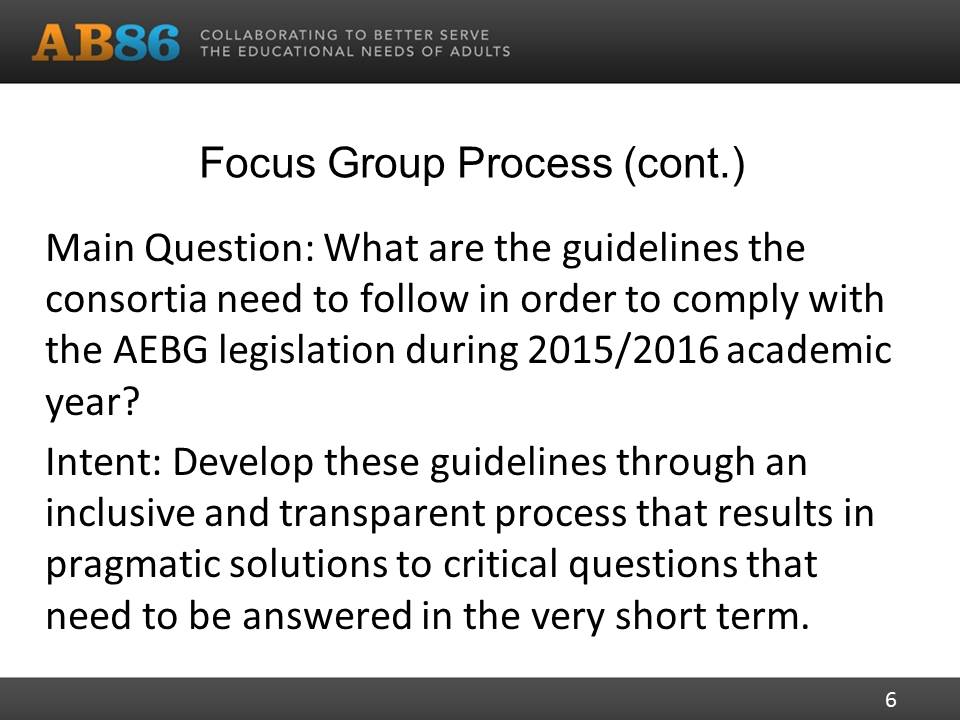
The July 10, 2015 Technical Webinar had a lot of helpful information to help guide us through new waters we're sailing through.

Implementation Focus Group's Draft Guidelines
        
     Listen to the Recording


The July 10, 2015 Technical Webinar had a lot of helpful information to help guide us through new waters we're sailing through.

Implementation Focus Group's Draft Guidelines
        
     Listen to the Recording


Selasa, 30 Juni 2015

adult history AB104: New Rules for a New Era in Adult Education - japraklupo

AB86 - Hallo sahabat fashion, Pada Artikel yang anda baca kali ini dengan judul AB86, kami telah mempersiapkan artikel ini dengan baik untuk anda baca dan ambil informasi didalamnya. mudah-mudahan isi postingan Artikel AB104, Artikel AB86, Artikel Budget, Artikel Democracy, Artikel Older Adults, yang kami tulis ini dapat anda pahami. baiklah, selamat membaca.

Judul : adult history AB104: New Rules for a New Era in Adult Education - japraklupo
link : adult history AB104: New Rules for a New Era in Adult Education - japraklupo

Baca juga


AB86

AB104 is the trailer bill about Adult Education.

Go here to read AB104 in full.

Go here to get to it via the AB86 website (the place to go for info about the new Regional Consortia system).

There are lots of things to learn and understand.

Here are a few bits. 

First, from the AB86 website:

AB104: Adult Education Block Grant

The California Legislature has passed Assembly Bill 104 which  includes the legislation for the Adult Education Block Grant. The Adult Education Block Grant will fund adult education providers and the adult education regional consortia.  Please refer to Sec. 39, Article 9, Section 84900.

What's Next?

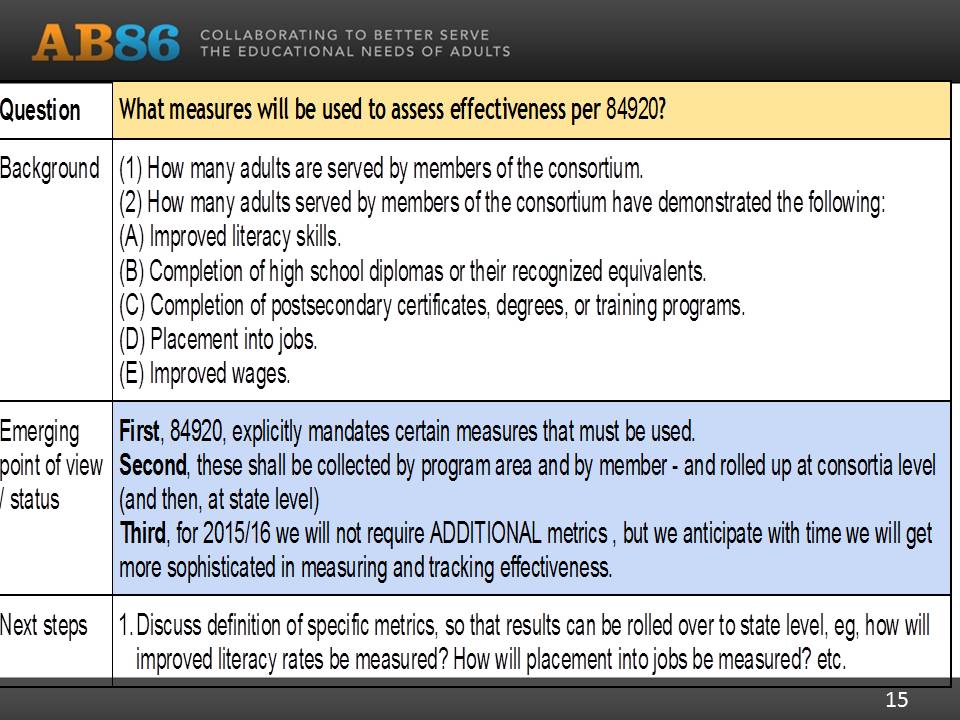
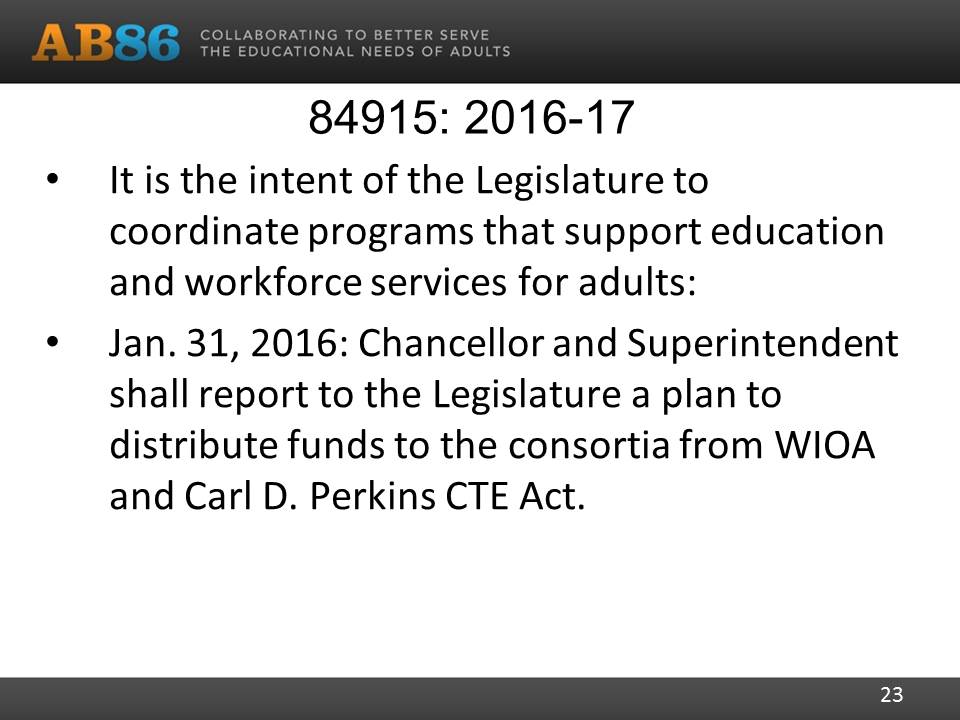
With this final language, the CCCCO and the CDE are working together to develop guidance regarding next steps for implementation of the Adult Education Block Grant. Guidance regarding the fund allocations,  reporting requirements, and outcomes and measures will be forthcoming over the coming weeks and months. We will be sure to keep you updated and will continue to provide technical assistance webinars to provide as much assistance as we can as we transition to implementation of your regional plans. Draft guidance is expected to be made public in July 2015.


From the CCAE Legislative Update:

Programs eligible for funding include:

o   Basic skills, high school equivalency/diploma
o   Citizenship, ESL
o   Workforce entry or reentry, including explicit ability for older adults to access these programs
o   Adult programs, including older adult access, that are "primarily designed to develop knowledge and skills to assist elementary and secondary school children to succeed academically in school" (a la child development for elementary and secondary school children)
o   Adults with disabilities programs
o   Short term career technical education
o   Pre-apprenticeship programs/activities


Section 39 
84913.
 (a) Funds apportioned for the program shall be used only for support of the following:
(1) Programs in elementary and secondary basic skills, including programs leading to a high school diploma or high school equivalency certificate.
(2) Programs for immigrants eligible for educational services in citizenship, English as a second language, and workforce preparation.
(3) Programs for adults, including, but not limited to, older adults, that are primarily related to entry or reentry into the workforce.
(4) Programs for adults, including, but not limited to, older adults, that are primarily designed to develop knowledge and skills to assist elementary and secondary school children to succeed academically in school.
(5) Programs for adults with disabilities.
(6) Programs in career technical education that are short term in nature and have high employment potential.
(7) Programs offering preapprenticeship training activities conducted in coordination with one or more apprenticeship programs approved by the Division of Apprenticeship Standards for the occupation and geographic area.
(b) A consortium may use no more than 5 percent of funds allocated in a given fiscal year for the sum of the following:
(1) The costs of administration of these programs.
(2) The costs of the consortium.
 

SEC. 22.

 Section 41976 of the Education Code is amended to read:
41976.
 (a) For purposes of this chapter, the following classes and courses are authorized to be offered by school districts and county superintendents of schools for apportionment purposes from the adult education fund:
(1) Adult programs in parenting, including parent cooperative preschools, and classes in child growth and development, parent-child relationships, and parenting.
(2) Adult programs in elementary and secondary basic skills and other courses and classes required for the high school diploma. Apportionments for these courses and classes may only be generated by students who do not possess a high school diploma, except for remedial academic courses or classes in reading, mathematics, and language arts.
(3) Adult education programs in English as a second language.
(4) Adult education programs for immigrants eligible for educational services in citizenship, English as a second language, and workforce preparation classes in the basic skills of speaking, listening, reading, writing, mathematics, decisionmaking and problem solving skills, and other classes required for preparation to participate in job specific technical training.
(5) Adult education programs for adults with disabilities.
(6) Adult short-term career technical education programs with high employment potential. Any reference to “vocational” education or programs in adult education means “career technical” education or programs in adult education.
(7) Adult programs for older adults.
(8) Programs offering pre-apprenticeship training activities conducted in coordination with one or more apprenticeship programs approved by the Division of Apprenticeship Standards for the occupation and geographic area.
(9) Adult programs in home economics.
(10) Adult programs in health and safety education.
(b) No state apportionment shall be made for any course or class that is not set forth in subdivision (a).
 
 
For comparison purposes, AB86 originally stated:

The purpose of AB 86 Section 76, Article 3 is to provide grant funds to regional consortium to create and implement a plan to better provide adults in its region with all of the following:

  • Elementary and secondary basic skills, including classes required for a high school diploma or high school equivalency certificate
  • Classes and courses for immigrants eligible for education services in citizenship and English as a second language and workforce preparation classes in basic skills
  • Education programs for adults with disabilities
  • Short-term career technical education programs with high employment potential
  • Programs for apprentices

AB104 is the trailer bill about Adult Education.

Go here to read AB104 in full.

Go here to get to it via the AB86 website (the place to go for info about the new Regional Consortia system).

There are lots of things to learn and understand.

Here are a few bits. 

First, from the AB86 website:

AB104: Adult Education Block Grant

The California Legislature has passed Assembly Bill 104 which  includes the legislation for the Adult Education Block Grant. The Adult Education Block Grant will fund adult education providers and the adult education regional consortia.  Please refer to Sec. 39, Article 9, Section 84900.

What's Next?

With this final language, the CCCCO and the CDE are working together to develop guidance regarding next steps for implementation of the Adult Education Block Grant. Guidance regarding the fund allocations,  reporting requirements, and outcomes and measures will be forthcoming over the coming weeks and months. We will be sure to keep you updated and will continue to provide technical assistance webinars to provide as much assistance as we can as we transition to implementation of your regional plans. Draft guidance is expected to be made public in July 2015.


From the CCAE Legislative Update:

Programs eligible for funding include:

o   Basic skills, high school equivalency/diploma
o   Citizenship, ESL
o   Workforce entry or reentry, including explicit ability for older adults to access these programs
o   Adult programs, including older adult access, that are "primarily designed to develop knowledge and skills to assist elementary and secondary school children to succeed academically in school" (a la child development for elementary and secondary school children)
o   Adults with disabilities programs
o   Short term career technical education
o   Pre-apprenticeship programs/activities


Section 39 
84913.
 (a) Funds apportioned for the program shall be used only for support of the following:
(1) Programs in elementary and secondary basic skills, including programs leading to a high school diploma or high school equivalency certificate.
(2) Programs for immigrants eligible for educational services in citizenship, English as a second language, and workforce preparation.
(3) Programs for adults, including, but not limited to, older adults, that are primarily related to entry or reentry into the workforce.
(4) Programs for adults, including, but not limited to, older adults, that are primarily designed to develop knowledge and skills to assist elementary and secondary school children to succeed academically in school.
(5) Programs for adults with disabilities.
(6) Programs in career technical education that are short term in nature and have high employment potential.
(7) Programs offering preapprenticeship training activities conducted in coordination with one or more apprenticeship programs approved by the Division of Apprenticeship Standards for the occupation and geographic area.
(b) A consortium may use no more than 5 percent of funds allocated in a given fiscal year for the sum of the following:
(1) The costs of administration of these programs.
(2) The costs of the consortium.
 

SEC. 22.

 Section 41976 of the Education Code is amended to read:
41976.
 (a) For purposes of this chapter, the following classes and courses are authorized to be offered by school districts and county superintendents of schools for apportionment purposes from the adult education fund:
(1) Adult programs in parenting, including parent cooperative preschools, and classes in child growth and development, parent-child relationships, and parenting.
(2) Adult programs in elementary and secondary basic skills and other courses and classes required for the high school diploma. Apportionments for these courses and classes may only be generated by students who do not possess a high school diploma, except for remedial academic courses or classes in reading, mathematics, and language arts.
(3) Adult education programs in English as a second language.
(4) Adult education programs for immigrants eligible for educational services in citizenship, English as a second language, and workforce preparation classes in the basic skills of speaking, listening, reading, writing, mathematics, decisionmaking and problem solving skills, and other classes required for preparation to participate in job specific technical training.
(5) Adult education programs for adults with disabilities.
(6) Adult short-term career technical education programs with high employment potential. Any reference to “vocational” education or programs in adult education means “career technical” education or programs in adult education.
(7) Adult programs for older adults.
(8) Programs offering pre-apprenticeship training activities conducted in coordination with one or more apprenticeship programs approved by the Division of Apprenticeship Standards for the occupation and geographic area.
(9) Adult programs in home economics.
(10) Adult programs in health and safety education.
(b) No state apportionment shall be made for any course or class that is not set forth in subdivision (a).
 
 
For comparison purposes, AB86 originally stated:

The purpose of AB 86 Section 76, Article 3 is to provide grant funds to regional consortium to create and implement a plan to better provide adults in its region with all of the following:

  • Elementary and secondary basic skills, including classes required for a high school diploma or high school equivalency certificate
  • Classes and courses for immigrants eligible for education services in citizenship and English as a second language and workforce preparation classes in basic skills
  • Education programs for adults with disabilities
  • Short-term career technical education programs with high employment potential
  • Programs for apprentices

adult history June 26, 2015 AB86 Technical Webinar: New Rules - japraklupo

AB86 - Hallo sahabat fashion, Pada Artikel yang anda baca kali ini dengan judul AB86, kami telah mempersiapkan artikel ini dengan baik untuk anda baca dan ambil informasi didalamnya. mudah-mudahan isi postingan Artikel AB86, Artikel Budget, Artikel Complicated, Artikel K12 and CC Coordination, yang kami tulis ini dapat anda pahami. baiklah, selamat membaca.

Judul : adult history June 26, 2015 AB86 Technical Webinar: New Rules - japraklupo
link : adult history June 26, 2015 AB86 Technical Webinar: New Rules - japraklupo

Baca juga


AB86

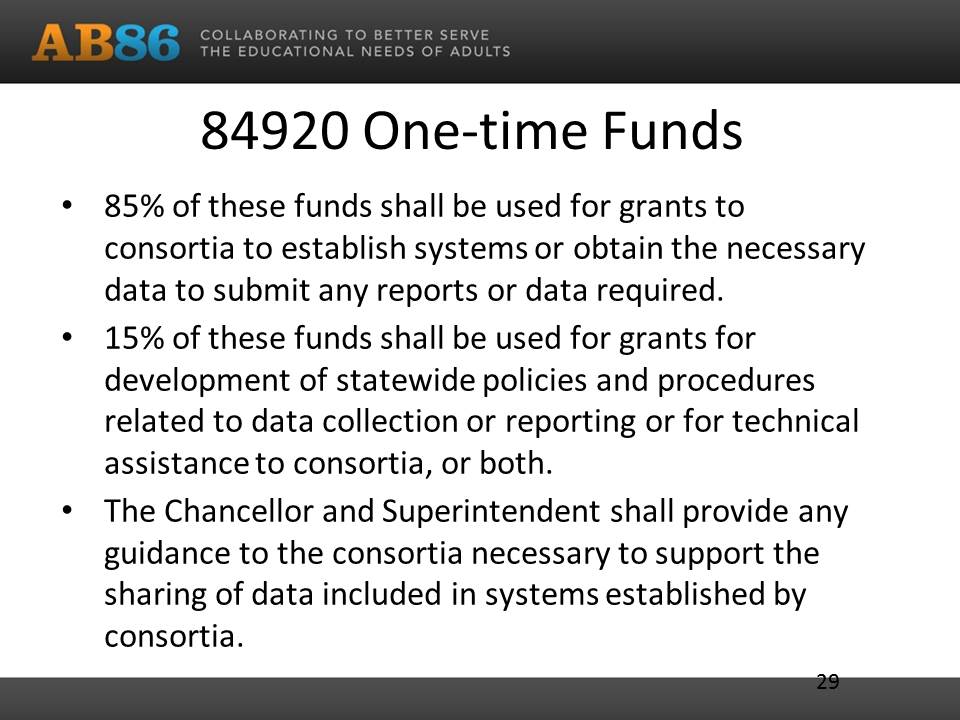
The latest AB86 Technical Webinar was all about the new rules.

Listen to the recording of the webinar here.

Here are the slides from the powerpoint.

Hit the link to see them.


The latest AB86 Technical Webinar was all about the new rules.

Listen to the recording of the webinar here.

Here are the slides from the powerpoint.

Hit the link to see them.